
Court Kicks Out NUP's Luyombya Godfrey Over Use of Another Name, Declares NRM's Kitosi Nakawa II Councillor
In a judgment delivered on October 29, 2026, Chief Magistrate Adoko Joe Fay ruled in favour of Kitosi in Election Petition No. 0002 of 2026, finding that irregularities in Luyombya’s nomination substantially affected the election and rendered the result liable to be overturned.

The Chief Magistrate’s Court of Nakawa has annulled the election of Godfrey Luyombya as directly elected councillor for Nakawa II Electoral Area in Kampala City and ordered him to vacate office immediately, declaring his election challenger, Emmanuel Kitosi, the validly elected councillor.
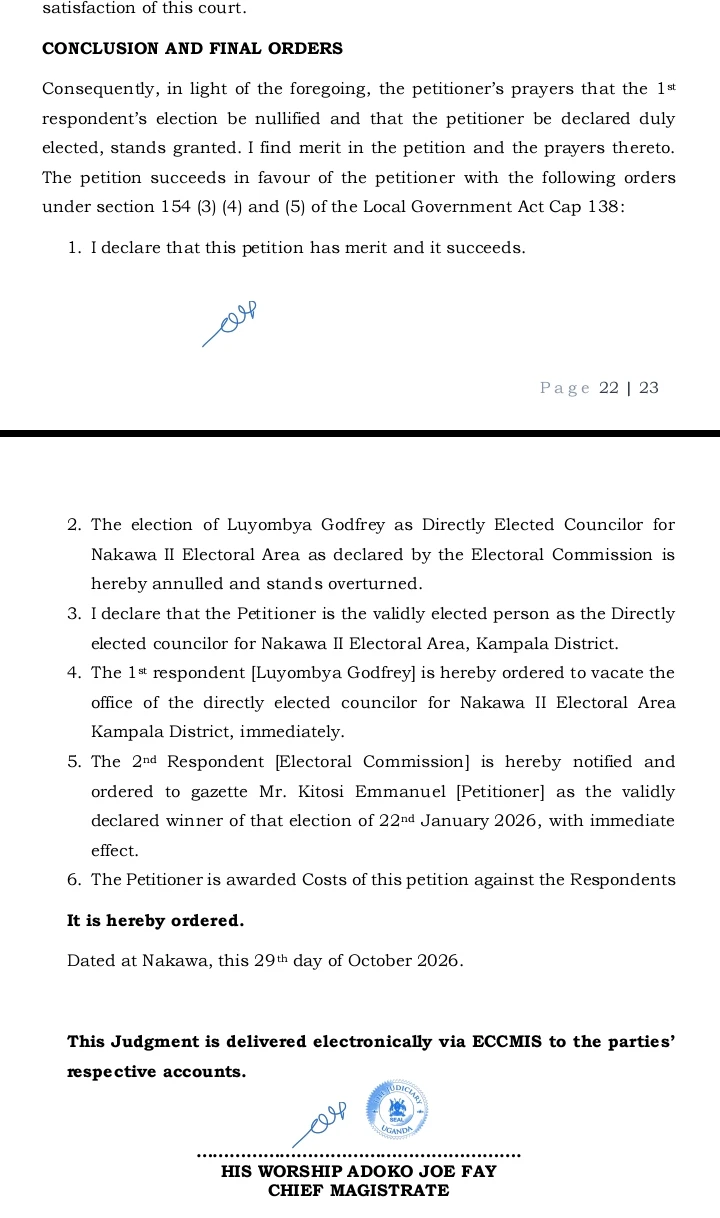
In a judgment delivered on October 29, 2026, Chief Magistrate Adoko Joe Fay ruled in favour of Kitosi in Election Petition No. 0002 of 2026, finding that irregularities in Luyombya’s nomination substantially affected the election and rendered the result liable to be overturned.
The court also ordered the Electoral Commission (EC) to gazette Kitosi as the validly declared winner of the election held on January 22, 2026, with immediate effect.
“The election of Luyombya Godfrey as Directly Elected Councilor for Nakawa II Electoral Area as declared by the Electoral Commission is hereby annulled and stands overturned,” the magistrate ruled.
The court further directed Luyombya to vacate the office of directly elected councillor for Nakawa II immediately and awarded Kitosi costs of the petition against the respondents.
Name discrepancy in nomination papers
The dispute centred on the validity of Luyombya’s nomination documents and whether the Electoral Commission had complied with the statutory requirements governing the nomination of candidates for local government elections.
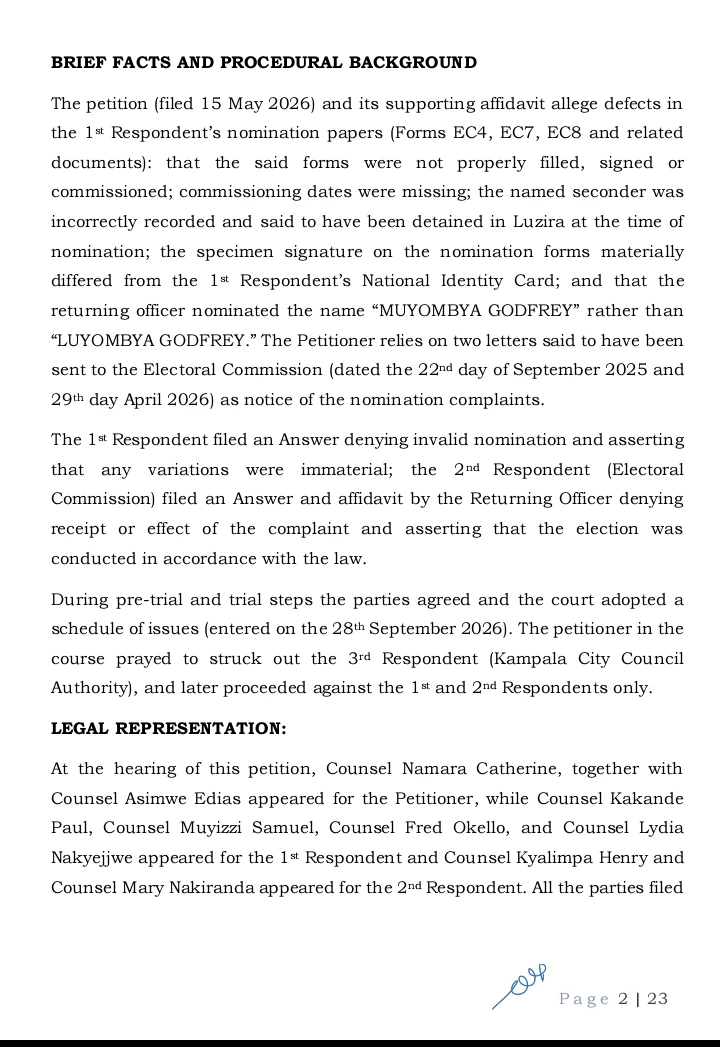
Kitosi filed the petition on May 15, 2026, challenging Luyombya’s election after the latter had been declared the winner and gazetted on May 8, 2026.
Among the issues raised by Kitosi were alleged defects in nomination forms, missing commissioning dates, questions surrounding the validity of the candidate’s supporting documents and a discrepancy between the name appearing in the nomination records and Luyombya’s actual name.
A central finding in the judgment was that the returning officer’s declaration identified the nominated candidate as “Muyombya Godfrey” rather than “Luyombya Godfrey.”
The court rejected the argument that the discrepancy could be treated as a mere typographical error or an accidental slip.
“I am not persuaded that this was a typographic error or accidental slip,” Adoko ruled, adding that the nomination process had to comply with the law governing elections.
The magistrate held that the Electoral Commission had nominated a person identified in the official records as Muyombya Godfrey, rather than the candidate whose election was subsequently challenged.
The judgment stated that the declaration made by the returning officer on September 3, 2025, did not establish a valid nomination for Luyombya under the name in which he contested the election.
The court concluded that the discrepancy was substantive and could not be cured by a general appeal to the principle of administering justice without undue regard to technicalities.
Court questions commissioning of documents
The court also examined the manner in which some of Luyombya’s nomination documents had been commissioned.
Kitosi had challenged forms EC6, EC7 and EC8, arguing that they were not properly endorsed by a commissioner for oaths and that the relevant dates and signatures required by the forms were missing.
In examining the documents, the magistrate observed that the commissioner’s name had been printed using a stamp and that, although a signature appeared alongside it, the space provided for the commissioner’s signature was blank and the documents did not indicate the dates on which they had been commissioned.
The court noted that other sections of the forms contained names, signatures and dates, while the sections relating to the commissioner for oaths presented a different pattern.
The magistrate said the advocate who had commissioned the documents was not called as a witness and no affidavit was presented to explain the procedure used.
The court subsequently considered whether the candidate had personally appeared before a commissioner for oaths, as required for documents that contain statements made under oath.
Citing previous court decisions on the commissioning of nomination documents and affidavits, Adoko held that failure to demonstrate proper commissioning could render the relevant instruments invalid.
“In this particular case at hand, the issue is different, all the copies bear no such, in fact there is none that is complete, all are without dates,” the judgment stated.
The magistrate concluded that the nomination documents did not meet the applicable legal requirements and that the Electoral Commission should have identified the defects during the nomination process.
Disputed seconder also featured in case
Another significant issue concerned the person named as a seconder in Luyombya’s nomination documents.
Kitosi argued that the named seconder, identified in the judgment as Kaija Doreen, had not validly seconded the nomination and was in detention at the relevant time.
The court found that the evidence presented by Kitosi on the seconder’s detention and the alleged failure to validly second the nomination had not been controverted by the respondents.
The magistrate considered the evidence alongside the discrepancies in the nomination records and the defects identified in the documents commissioned for the nomination.
The court ultimately found that the irregularities went beyond minor administrative mistakes and affected the legal validity of the nomination. Under Section 132(4) of the Local Governments Act, the nomination of a local government council candidate must comply with prescribed requirements, including the relevant nomination forms, supporting documents and statements required by law.
The magistrate held that compliance with these requirements was essential to the integrity of the electoral process.
Court rejects argument based on vote margin
The judgment also addressed the question of whether the nomination irregularities substantially affected the election result, a requirement under Section 151(a) of the Local Governments Act for setting aside an election on grounds of non-compliance.
According to the figures cited in the judgment, Luyombya had been declared the winner with 5,066 votes against Kitosi’s 2,729, giving Luyombya a margin of 2,337 votes.
However, the court held that the numerical margin could not, by itself, validate a nomination that had failed to comply with the law.
The magistrate reasoned that the case was not simply about correcting vote totals or establishing whether particular ballots had been excluded. It concerned whether Luyombya had been validly nominated and was therefore entitled to participate in the election in the first place.
The court found that, had the Electoral Commission complied with the applicable nomination requirements, Luyombya would not have appeared on the ballot in the circumstances established by the evidence.
The judgment stated that the irregularities had a substantial effect on the election because the validity of the candidate’s participation was itself in question.
The magistrate consequently found that Kitosi had proved the ground for setting aside the election under Section 151(a) of the Local Governments Act.
Electoral Commission faulted over complaint
The judgment also examined the handling of complaints Kitosi said he had previously raised with the Electoral Commission concerning Luyombya’s nomination.
Kitosi relied on letters dated September 22, 2025, and April 29, 2026, which he said had brought the alleged nomination defects to the attention of the commission.
The respondents argued that nomination complaints should ordinarily be addressed through the statutory procedures provided under the Electoral Commission Act before polling.
However, the court found that the commission had not presented evidence of a decision resolving Kitosi’s complaint.
The magistrate held that the commission’s failure to determine a complaint did not automatically prevent an aggrieved person from raising the same issue in an election petition.
“Silence on a complaint, in my humble view, doesn’t mean or amount to a decision of the Commission,” the judgment stated.
The court concluded that Kitosi’s petition was properly before it and that it had jurisdiction to examine the nomination irregularities.
It subsequently found that the Electoral Commission had failed to ensure compliance with the statutory requirements governing Luyombya’s nomination.
Kitosi declared validly elected
Having found that the election was affected by substantial non-compliance with the law, the court turned to the remedies available to Kitosi.
The petitioner had asked the court to nullify Luyombya’s election and declare him the duly elected councillor for Nakawa II.
The magistrate granted both prayers, ruling that Kitosi had established the grounds for setting aside Luyombya’s election and had provided the evidence required to support a declaration that he was validly elected.
In its final orders, the court declared that the petition had merit and succeeded.
It annulled Luyombya’s election, declared Kitosi the validly elected directly elected councillor for Nakawa II Electoral Area, ordered Luyombya to vacate office immediately and directed the Electoral Commission to gazette Kitosi as the winner of the January 22 election.
The court also awarded Kitosi the costs of the petition against the respondents.
The judgment was dated October 29, 2026, and delivered electronically through the Electronic Court Case Management Information System (ECCMIS) to the parties’ respective accounts.
Implications for local government elections
The ruling underscores the importance of strict compliance with nomination requirements in Uganda’s local government electoral process.
It also highlights the responsibility of electoral officials to scrutinise nomination documents carefully and address complaints in accordance with the law.
For Nakawa II, the immediate consequence of the judgment is a change in the person the court recognises as the validly elected councillor, with the Electoral Commission directed to give effect to the decision through gazettement.
The judgment places the nomination process, the accuracy of official electoral records and the handling of pre-election complaints at the centre of the dispute.
The court’s decision was based on the specific evidence and legal issues presented in Kitosi’s petition, particularly the discrepancy in the nominee’s name and the defects the magistrate identified in the commissioning of nomination documents.
The final orders are explicit:
Luyombya’s election has been annulled, Kitosi has been declared the validly elected councillor, and Luyombya has been directed to vacate office immediately.*

John Kusolo is a Pastor, Sports Enthusiast and Ugandan journalist with Nile Chronicles News (NCN). With a strong commitment to journalistic excellence, he is recognized for his dedication, goal-oriented approach, and ability to thrive in challenging environments. Kusolo brings focused motivation and professionalism to his reporting and media assignments.

















Comments (0)