
Aimable Mbarushimana Recognised by African Union for Advancing Africa’s Feed and Fodder Sector
Mbarushimana officially received the award on October 26, 2026, during a presentation in Uganda by Dr. Anna Rose Okurut Ademun, Uganda’s Chief Veterinary Officer and Commissioner for Animal Health, alongside Dr. Denis Mulongo Maholo, Assistant Commissioner for Animal Nutrition.
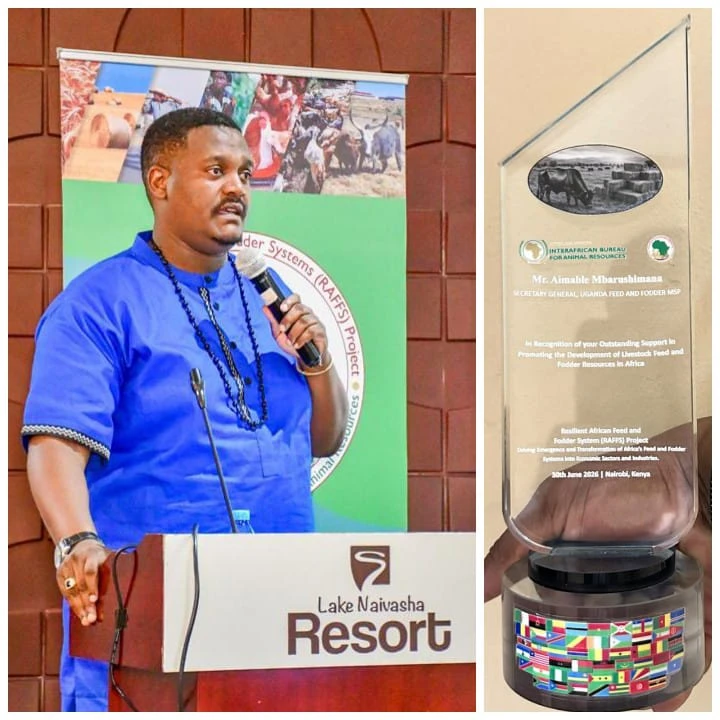
Uganda Animal Feeds Manufacturers Association (UGAFMA) Chairman Aimable Mbarushimana has been recognised by the African Union–Inter-African Bureau for Animal Resources (AU-IBAR) for his contribution to the development of Africa’s livestock feed and fodder sector.
The recognition, which was awarded on June 30, 2026, in Nairobi, Kenya, acknowledges Mbarushimana’s efforts to promote sustainable feed and fodder systems, strengthen local feed manufacturing and advance private-sector participation in the livestock value chain.
Mbarushimana officially received the award on October 26, 2026, during a presentation in Uganda by Dr. Anna Rose Okurut Ademun, Uganda’s Chief Veterinary Officer and Commissioner for Animal Health, alongside Dr. Denis Mulongo Maholo, Assistant Commissioner for Animal Nutrition.
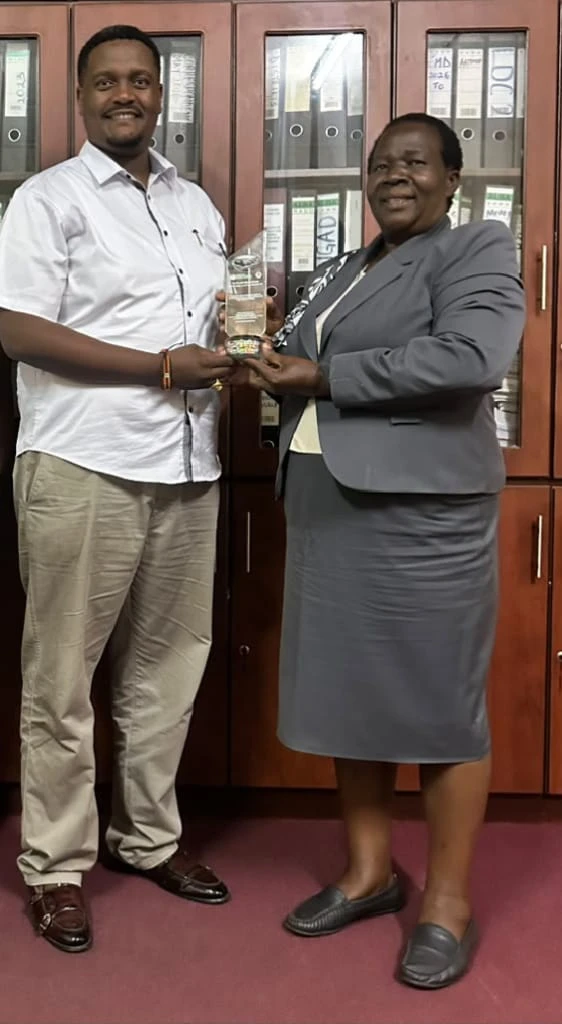
Chairman Aimable Mbarushimana(L) receives his recognition award on 26th October 2026 from Dr. Anna Rose Okurut Ademun, Chief Veterinary Officer and Commissioner Animal Health, Uganda(R)
The recognition marks an important milestone in his professional journey, which has involved working with government institutions, industry players and development partners to strengthen Uganda’s animal feed industry and contribute to broader efforts to improve livestock production across Africa.
It also highlights the growing importance of reliable, affordable and quality-assured animal feeds in building resilient livestock systems, improving agricultural productivity and supporting the livelihoods of farmers.
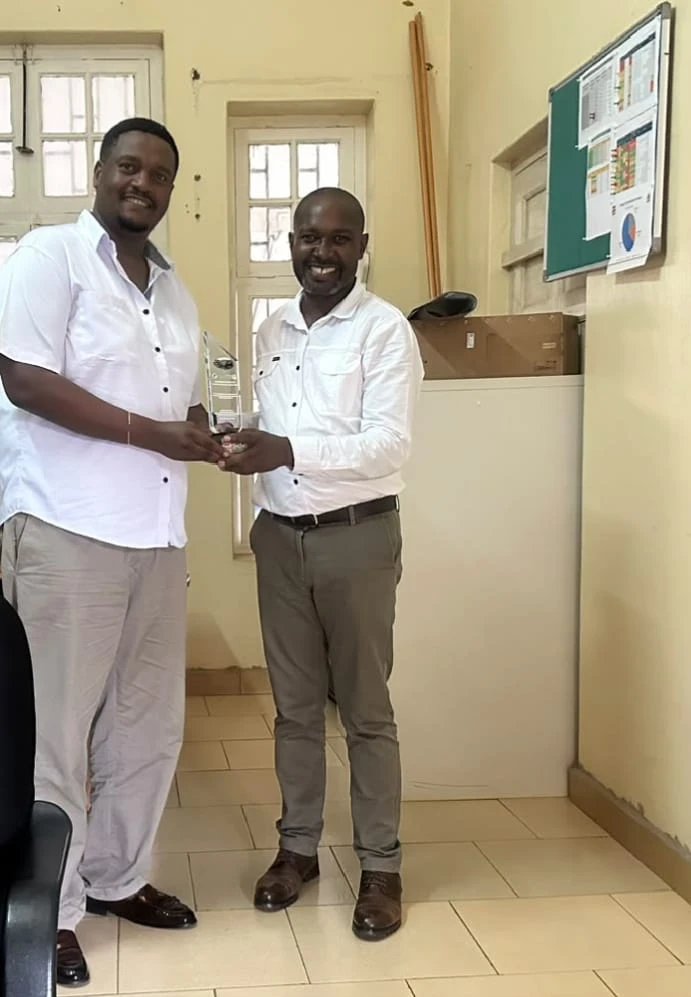
Chairman Aimable Mbarushimana(L) receives his recognition award on 26th October 2026 from Dr. Denis Mulongo Maholo(R), Assistant Commissioner–Animal Nutrition, in recognition of his contribution to livestock feed and fodder development in Africa.
From Naivasha to Nairobi
Mbarushimana’s recognition is linked to his participation in the Resilient African Feed and Fodder Systems (RAFFS) Project, an initiative implemented by AU-IBAR with support from the Gates Foundation and the African Union Commission.
The project ran from December 2022 to June 2026 across six African countries, seeking to strengthen feed and fodder systems affected by climate shocks, the COVID-19 pandemic and disruptions to global supply chains.
These challenges exposed vulnerabilities in livestock production, including shortages of feed ingredients, rising production costs and difficulties in maintaining consistent supplies of nutritious animal feeds.
Against this background, the RAFFS initiative sought to support more resilient and sustainable feed and fodder systems capable of withstanding external shocks while responding to the changing needs of Africa’s livestock sector.
Mbarushimana contributed Uganda’s private-sector perspective to the initiative, advocating for stronger domestic feed manufacturing, agricultural value addition, improved quality standards and increased investment in the industry.
His involvement reflected the need to bring together policymakers, feed manufacturers, farmers and development partners to address the structural challenges affecting livestock feed production and distribution.
The recognition in Nairobi therefore represents more than an individual professional achievement. It also underscores the importance of private-sector participation in shaping policies and programmes that support the development of Africa’s livestock industry.
Strengthening Uganda’s Feed and Fodder Sector
Between 2023 and 2026, Mbarushimana served as Secretary General of the Uganda Feed and Fodder Multi-Stakeholder Platform (MSP), where he worked with government institutions, industry leaders and development partners to strengthen coordination and promote sustainable sector development.
The platform provides an avenue for stakeholders across the feed and fodder value chain to engage on policy issues, identify investment opportunities and work towards solutions to common industry challenges.
During his tenure, Mbarushimana supported efforts to strengthen public-private dialogue and promote a coordinated approach to developing Uganda’s feed and fodder industry.
He acknowledged the contribution of Mr. Aga Sekalala Jr., Chairman of the Uganda Feed and Fodder MSP, together with Dr. Anna Rose Okurut Ademun and Dr. Denis Mulongo Maholo, whose leadership and technical contributions supported the sector’s development.
He also recognised David Maina, Business Development Expert at AU-IBAR, and Dr. Sarah Ashanut Ossiya for their technical guidance and coordination throughout the RAFFS initiative.
Dr.Sarah Ashanut Ossiya is an animal production expert and the Project Coordinator for the Resilient African Feed and Fodder Systems (RAFFS) project at the African Union-InterAfrican Bureau for Animal Resources (AU-IBAR).
According to Mbarushimana, the collective efforts of the different stakeholders have helped position the Uganda Feed and Fodder MSP as an important platform for policy advocacy, collaboration and investment promotion.
The platform’s work is particularly significant in a country where agriculture remains a major source of livelihoods and livestock production contributes to household incomes, food security and the wider agricultural economy.
A stronger feed and fodder industry can help livestock farmers improve productivity, manage production costs and access more reliable supplies of nutritious feed.
It can also create opportunities for manufacturers, traders, farmers and other businesses involved in producing, processing and distributing feed ingredients.
Uganda’s Potential in Local Feed Manufacturing
As Uganda seeks to strengthen its livestock sector, Mbarushimana believes the country has significant potential to turn locally produced agricultural commodities into high-quality animal feeds.
Maize, soybeans, sunflower, cottonseed and other agricultural products can serve as important raw materials for the manufacture of livestock feeds.
Expanding local processing would provide an opportunity to add value to agricultural produce, create markets for farmers and reduce dependence on imported feed ingredients and finished products where competitive domestic alternatives can be developed.
However, realising this potential requires deliberate investment and a supportive policy environment.
Mbarushimana has identified stronger policies, investment in local manufacturing, improved quality assurance, affordable financing and closer collaboration between government and the private sector as important priorities for the industry.
Quality assurance is particularly important because animal feeds must meet appropriate nutritional and safety standards to support livestock growth, productivity and health.
Reliable quality standards can also strengthen consumer confidence, encourage investment and help responsible manufacturers compete in the domestic market.
Meanwhile, access to affordable financing would enable feed manufacturers to invest in processing equipment, expand production capacity, improve storage facilities and strengthen distribution networks.
Better coordination between crop farmers and feed manufacturers could also help establish more dependable supply chains for raw materials, creating opportunities for agricultural value addition while improving the availability of feed ingredients.
These interventions could contribute to a more competitive domestic feed industry and support the wider development of Uganda’s livestock value chain.
New Responsibility in Advocacy
Following his service as Secretary General of the Uganda Feed and Fodder MSP from 2023 to 2026, Mbarushimana has taken on a new responsibility as Head of the platform’s Advocacy Technical Working Group for 2026–2027.
He will continue serving as Chairman of UGAFMA, maintaining his involvement in both industry representation and stakeholder engagement.
The new role places advocacy among the key areas of his continued contribution to the sector, particularly in promoting policies and investments that support domestic feed manufacturing and sustainable livestock production.
His priorities include encouraging government and private-sector partnerships, strengthening the operating environment for feed manufacturers and promoting greater recognition of the role animal nutrition plays in agricultural transformation.
Effective advocacy can help bring industry challenges to the attention of policymakers, encourage the adoption of appropriate standards and mobilise investment towards areas where the feed and fodder value chain requires additional support.
The work also offers an opportunity to build on the relationships and experience developed through the RAFFS Project and the Uganda Feed and Fodder MSP.
Although the RAFFS Project officially concluded in June 2026, Mbarushimana believes its achievements should provide a foundation for continued progress rather than mark the end of efforts to strengthen Africa’s feed and fodder systems.
Sustaining the Gains
Beyond the RAFFS Project The conclusion of the RAFFS Project presents an opportunity for participating countries and stakeholders to consolidate the progress made and sustain collaboration beyond the project period.
For Uganda, this means translating policy discussions, stakeholder coordination and investment priorities into practical interventions that benefit feed manufacturers, farmers and livestock producers.
Continued engagement among government agencies, private-sector associations, research institutions and development partners will be important in addressing persistent challenges in feed availability, affordability, quality and distribution.
The country’s agricultural sector also stands to benefit from stronger links between crop production and livestock farming, particularly through the processing of locally available raw materials into value-added products.
Such linkages could support rural employment, expand markets for agricultural produce and improve the efficiency of the livestock value chain.
At the continental level, resilient feed and fodder systems are essential to helping African countries respond to climate-related pressures, economic disruptions and changing demand for livestock products.
The long-term success of these efforts will depend on sustained investment, effective policies, strong institutions and the ability of stakeholders to work together beyond individual projects.
A Recognition Shared With Stakeholders
Mbarushimana has expressed appreciation to AU-IBAR, the African Union Commission, the Gates Foundation, the leadership of the Uganda Feed and Fodder MSP, UGAFMA members and other stakeholders who contributed to the journey.
He emphasised that the recognition should be viewed as a collective achievement reflecting the efforts of individuals and institutions committed to building a stronger African livestock industry.
His message also points to a broader development priority: improving livestock production requires more than increasing animal numbers. It requires investment in the systems that sustain them, including animal nutrition, feed manufacturing, quality control and reliable supply chains.
For Uganda, strengthening these systems could help unlock the value of locally available agricultural resources while supporting livestock farmers and businesses across the country.
From the early engagements in Naivasha to the recognition in Nairobi and its official presentation in Uganda, Mbarushimana’s journey reflects the growing role of private-sector leadership in advancing agricultural development.
As he begins his new assignment in advocacy while continuing to lead UGAFMA, the challenge will be to build on the recognition and translate the sector’s priorities into lasting improvements for Uganda’s feed and fodder industry.
His central message remains that Africa’s livestock future depends not only on the animals raised, but also on the systems developed to feed them.
To transform African livestock, Africa must first transform its feed and fodder systems. ---
About Aimable Mbarushimana
Aimable Mbarushimana is Chairman of the Uganda Animal Feeds Manufacturers Association (UGAFMA) and Head of the Advocacy Technical Working Group of the Uganda Feed and Fodder Multi-Stakeholder Platform for 2026–2027. He previously served as Secretary General of the Uganda Feed and Fodder MSP from 2023 to 2026.

John Kusolo is a Pastor, Sports Enthusiast and Ugandan journalist with Nile Chronicles News (NCN). With a strong commitment to journalistic excellence, he is recognized for his dedication, goal-oriented approach, and ability to thrive in challenging environments. Kusolo brings focused motivation and professionalism to his reporting and media assignments.











Comments (0)