
UGANDA TO CONDUCT ITS FIRST EVER NATIONAL BUILDINGS SURVEY AS UBOS AND NBRB SIGN LANDMARK PARTNERSHIP
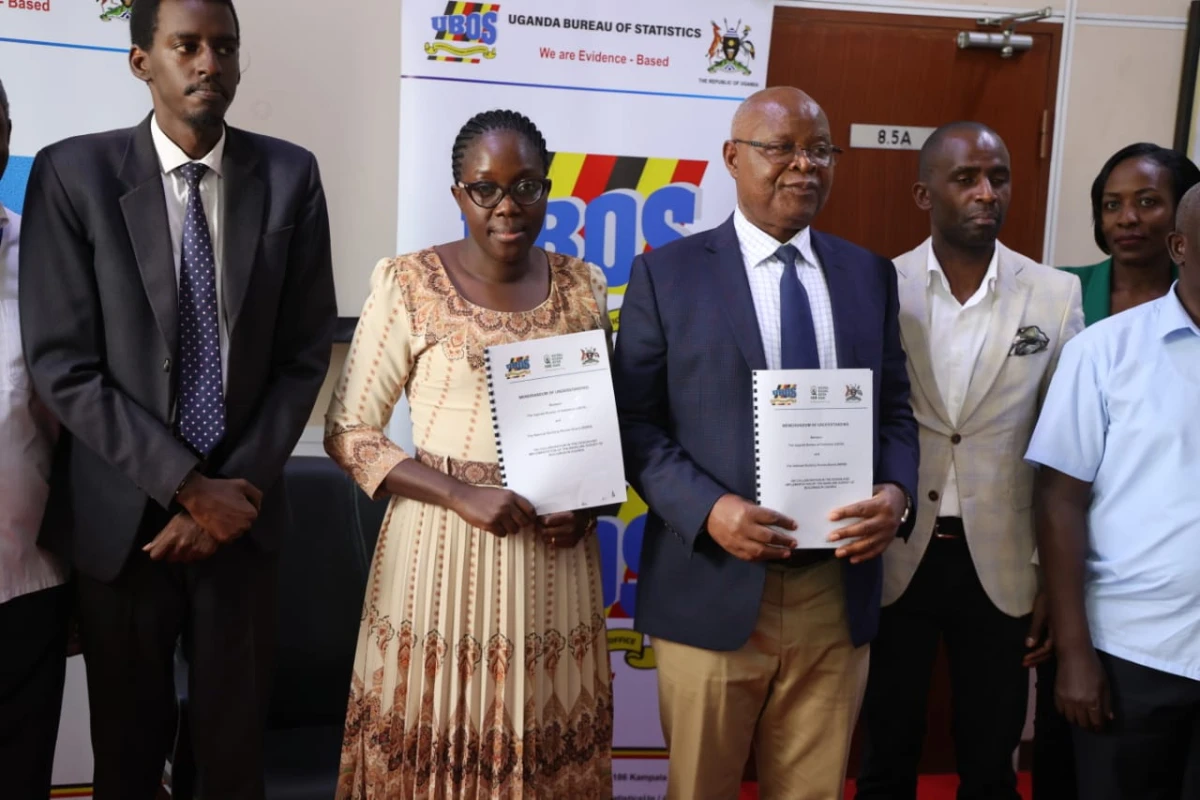
Uganda is set to conduct its first ever comprehensive national survey of buildings after the Uganda Bureau of Statistics and the National Building Review Board on Thursday signed a Memorandum of Understanding to design and implement what will be a landmark exercise in the country's statistical and infrastructure planning history.
The MoU was signed at Statistics House on 7th August 2026 during a ceremony presided over by UBOS Executive Director Dr Chris Mukiza, with the NBRB delegation led by its Executive Secretary Eng Flavia Gutto Bwire, marking the formal birth of a partnership that both institutions described as long overdue.
For the first time, Uganda will have a structured, data-driven answer to questions that planners, regulators, investors and disaster risk managers have long been unable to answer with any precision, how many buildings exist across the country, what condition are they in, how many comply with building regulations, who owns them, how are they occupied and where exactly are they located.
The Baseline Survey of Buildings will collect data on building characteristics, structural conditions, compliance with building regulations, ownership, occupancy and the spatial distribution of buildings across Uganda, generating a comprehensive national inventory that currently does not exist in any reliable form.
Dr Mukiza said the collaboration demonstrates the value of strategic partnerships in strengthening Uganda's National Statistical System and ensuring that planning and policy decisions are grounded in credible, evidence-based data. "Reliable statistics are the foundation of sound policy, effective service delivery and informed investment decisions," he said, adding that the survey would significantly improve the country's capacity to plan, regulate and manage its built environment.
The significance of the exercise extends well beyond statistical completeness. Uganda has in recent years faced recurring incidents of building collapses, illegal construction and unregulated urban expansion, problems that regulators have struggled to address partly because no comprehensive baseline data exists on the country's building stock.
The survey's findings are expected to directly support infrastructure planning, regulation of the construction industry, disaster risk reduction and the monitoring of building standards across the country.
To ensure rigorous implementation, UBOS and NBRB agreed to establish a Joint Technical Committee that will oversee every stage of the exercise, from survey methodology and questionnaire development through pilot testing, field operations, data processing, validation and the dissemination of results.
Under the terms of the MoU, UBOS will provide technical leadership in survey design, statistical methodology, quality assurance, data processing, analysis and dissemination of findings. NBRB will coordinate survey implementation, mobilise resources and contribute technical expertise on building inspection, standards and regulatory compliance, drawing on its mandate as the body responsible for overseeing building safety and construction standards in Uganda.
The survey's findings are expected to serve a wide range of users, including government planners, private investors, development partners and urban authorities, by providing accurate and timely statistics on Uganda's building stock that can inform investment decisions, zoning policies, safety interventions and long term urban development strategies.
Eng Gutto Bwire said the partnership represented a decisive step toward bringing Uganda's building sector under the kind of data-driven oversight that sustainable urban development demands, and pledged the NBRB's full commitment to the exercise.
Once completed, the Baseline Survey of Buildings is expected to become a foundational reference for Uganda's construction and infrastructure sectors, providing the evidence base that regulators, planners and policymakers have long needed to make decisions about one of the fastest growing built environments in East Africa.

Benjamin Mwibo is a talented, passionate and creative journalist with a commitment to high quality out put that is factual and researched. Above all Dedicated with a strong desire to identify the truth of the matter.














Comments (0)