
PROF. BALUNYWA: HAND HOES IN 2026? WE CANNOT HOE OUR WAY OUT OF POVERTY
But here is a question we must confront: If we were using hand hoes when I was born, why are we still celebrating their distribution in Uganda in 2026?
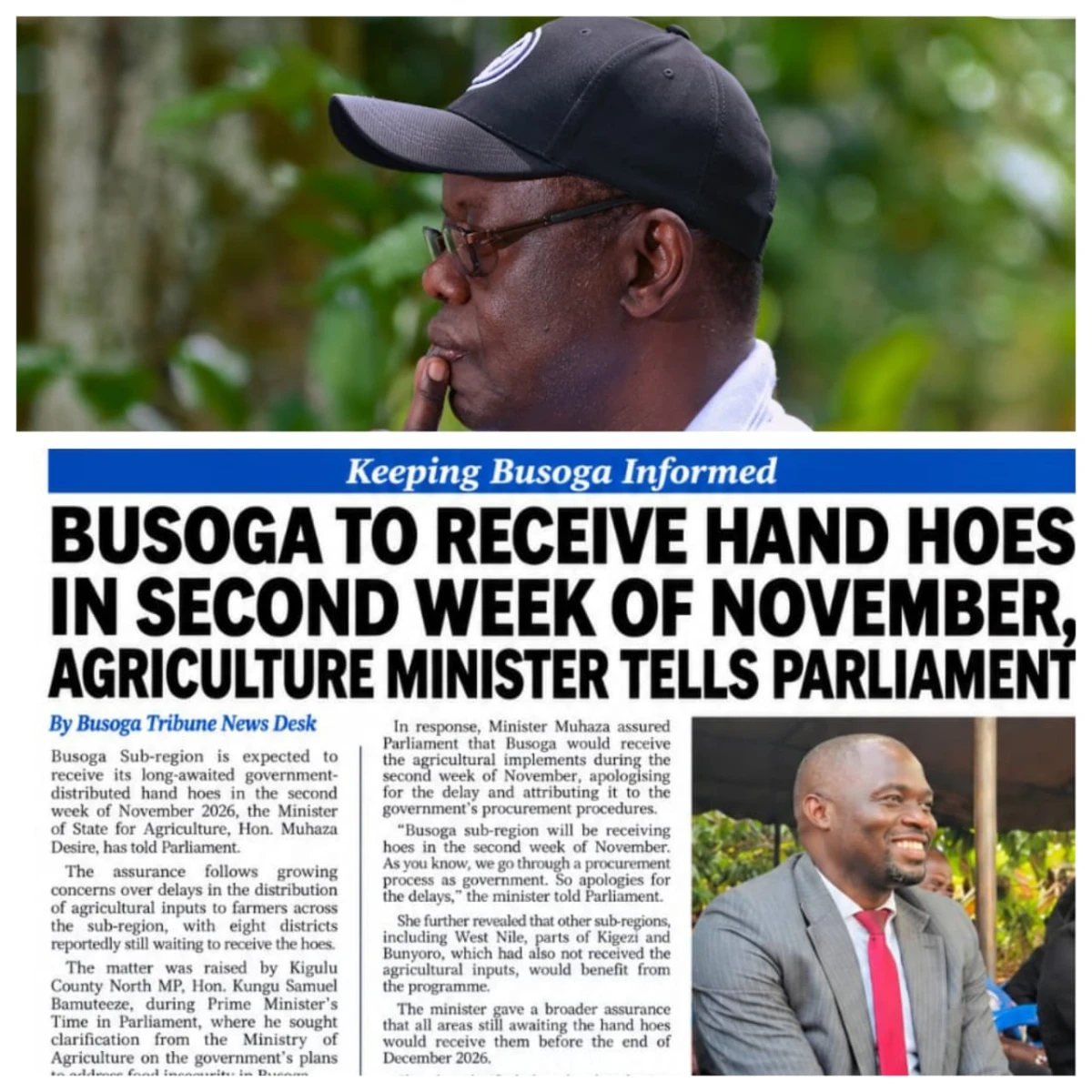
By Prof. Waswa Balunywa
I was born many years ago in a village where the hand hoe was the main tool of farming. Our parents and grandparents depended on it to cultivate their gardens, feed their families, and earn a living. They worked hard with the tools available to them.
But here is a question we must confront: If we were using hand hoes when I was born, why are we still celebrating their distribution in Uganda in 2026?
As Busoga prepares to receive hand hoes in the second week of November, we must ask whether this intervention can genuinely transform agriculture, increase household incomes, and lift our people out of poverty.
I do not question the intention to support farmers. Our farmers need support. However, we must ask whether the assistance we provide matches the scale of the challenge we face.
We cannot continue using yesterday's tools and expect tomorrow's results.
Across the world, agriculture has advanced through mechanisation, improved seeds, irrigation, fertilisers and digital technologies. Farmers can cultivate larger areas, improve yields and reduce losses. Yet in Uganda, millions still depend on the hand hoe as their primary farming tool.
The announcement that eight districts in Busoga have been waiting for hand hoes, alongside communities in West Nile, Kigezi and Bunyoro, should prompt serious reflection. If households cannot afford a basic agricultural tool costing only a few thousand shillings, we must recognise the depth of poverty confronting them.
The problem is not the hand hoe itself. It is the economic condition of the farmer who depends on it.
A farmer who cannot afford quality seeds, fertilisers, or access to reliable markets remains trapped in a cycle of low production and low income. Giving that farmer another hand hoe may help with immediate cultivation, but it does little to change the circumstances that keep the household poor.
We must distinguish between helping people survive and helping them prosper.
Consider the labour required to cultivate an acre using a hand hoe. It is physically demanding and time-consuming. The same work can be accomplished much faster using an ox-plough, a power tiller or a tractor. Mechanisation allows farmers to cultivate more land, reduce labour costs and redirect their efforts towards other productive activities.
Not every farmer needs to own a tractor. Governments, cooperatives and private investors can establish affordable machinery-hiring services. Draught animals can also provide a practical alternative where appropriate.
A hand hoe helps a farmer dig. Modern agricultural systems help a farmer build an enterprise.
We must therefore pursue three priorities. First, we must mechanise agriculture by improving access to affordable machinery, irrigation and appropriate technologies. Second, we must educate farmers in improved farming methods, soil management, fertiliser use, pest control and post-harvest handling. Farmers should understand not only how to cultivate an acre, but also how much it costs to produce, where the harvest will be sold and what profit they can expect.
Third, we must change our mindset about poverty. Government assistance is important, particularly for vulnerable households, but it should build lasting productive capacity. Our goal must be to move people from subsistence to commercial production and from dependence to enterprise.
This requires affordable finance, reliable markets, storage facilities, and better transport infrastructure. We cannot transform agriculture by distributing tools alone while ignoring the conditions that determine whether farmers succeed.
Busoga has hardworking people and enormous agricultural potential. The challenge is to turn that potential into prosperity. We should measure progress by improvements in farm productivity, household incomes, commercial production and market access, not simply by the number of hand hoes distributed.
This is not an argument against supporting farmers. It is an argument for supporting them better. Where households need immediate assistance, we should help them. But we must also create pathways for them to become economically independent.
The same principle applies across Uganda. We cannot transform our economy while millions remain trapped in low-productivity agriculture. Farming must become more profitable, productive, and attractive to young people.
It is time to GET UP AND GO. Nobody owes us a living. Not government, not donors. We must embrace appropriate technologies, improve our skills, and take responsibility for our economic transformation.
Our farmers deserve more than endless back-breaking labour. They deserve the tools, knowledge and opportunities to prosper.
Let us stop celebrating hand hoes as symbols of agricultural progress in 2026. Let us celebrate tractors, irrigation, productive farms, value addition and farmers who earn decent incomes.
We cannot hoe our way out of poverty. We must think our way out of it, organise our way out of it, and produce our way out of it.
The time for transformation is now.
Jwbmedia

John Kusolo is a Pastor, Sports Enthusiast and Ugandan journalist with Nile Chronicles News (NCN). With a strong commitment to journalistic excellence, he is recognized for his dedication, goal-oriented approach, and ability to thrive in challenging environments. Kusolo brings focused motivation and professionalism to his reporting and media assignments.











Comments (0)