
Umukuuka Mudoma Warns Politicians Against Interfering in Bugisu Cultural Institution
In a detailed cultural guidance address titled “Guarding the Throne: A Mandate on Cultural Sovereignty and Civic Responsibility,” the Umukuuka called on Members of Parliament from Bugisu, members of the 26-clan council, elders and the wider Bamasaaba community to protect their cultural heritage and maintain clear boundaries between political leadership and traditional authority.
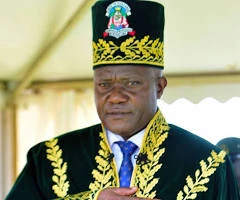
His Highness Sir Jude Mike Mudoma III, the Umukuuka of Bugisu, has issued a strong message urging political leaders to respect the authority, independence and traditions of the Bugisu Cultural Institution, warning that interference in cultural affairs could undermine social cohesion and threaten the stability of the Bamasaaba community.
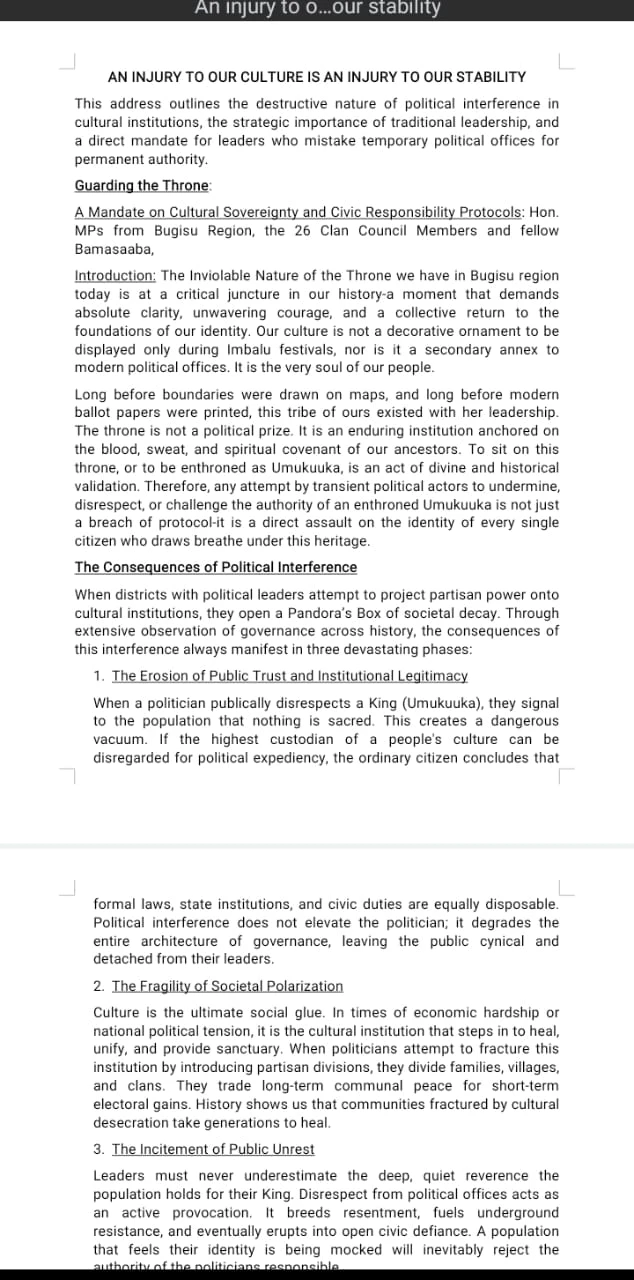
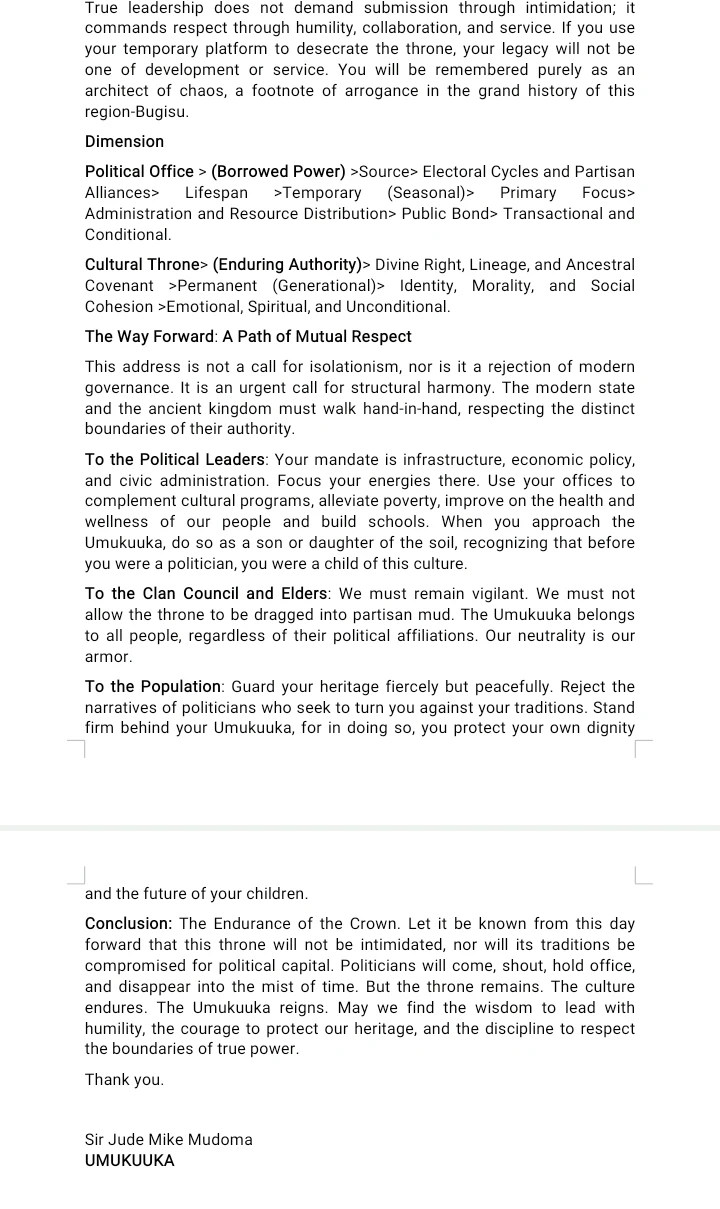
In a detailed cultural guidance address titled “Guarding the Throne: A Mandate on Cultural Sovereignty and Civic Responsibility,” the Umukuuka called on Members of Parliament from Bugisu, members of the 26-clan council, elders and the wider Bamasaaba community to protect their cultural heritage and maintain clear boundaries between political leadership and traditional authority.
Hon. Steven Masiga, the spokesperson of the Bugisu Cultural Institution, confirmed to Nile Chronicles that the Umukuuka had released the guidance outlining how politicians should respect the cultural institution and refrain from actions that could injure or undermine Bugisu's traditions.
The message comes with a strong appeal for mutual respect between elected leaders and traditional institutions, with the Umukuuka emphasising that culture should not be treated as a political instrument or reduced to ceremonial activities during the Imbalu circumcision season.
“Our culture is not a decorative ornament to be displayed only during Imbalu festivals, nor is it a secondary annex to modern political offices. It is the very soul of our people,” the Umukuuka stated in his address.
He argued that the Bamasaaba cultural institution predates modern political structures and remains central to the community's identity, history, values and collective heritage.
Political offices are temporary, cultural institutions endure
A central message in the address is the distinction between elected political offices and traditional cultural leadership.
The Umukuuka observed that political offices operate within electoral cycles and depend on changing political alliances and the electorate's decisions, while cultural institutions draw their significance from the community's historical traditions, ancestry and shared identity.
He cautioned political leaders against allowing the authority associated with public office to become a basis for disregarding traditional leadership.
“To those district leaders and political actors who have grown arrogant because of a temporary title, a state vehicle, or a momentary mandate: hear this truth clearly. You have not ‘arrived.’ You are merely passing through,” he said.
He added that political authority is entrusted to leaders by the people and should be exercised in accordance with the law, humility and responsibility.
According to the Umukuuka, using political positions to challenge or undermine cultural institutions does not demonstrate strength but risks creating unnecessary divisions between leaders and the communities they serve.
He warned that leaders who disregard cultural sensitivities could damage their relationships with the people and leave behind a legacy of division rather than cooperation.
Warns of erosion of public trust and social cohesion
The Umukuuka identified three potential consequences of political interference in cultural institutions: the erosion of public trust, increased social polarisation and the risk of public unrest.
He argued that publicly disrespecting a traditional leader could weaken confidence in the wider institutional framework by creating the perception that established customs and social values can be disregarded for political convenience.
He further described culture as a unifying force that helps communities navigate economic hardship, political tensions and other social challenges.
According to the address, cultural institutions provide a platform for reconciliation, unity and the preservation of shared values across families, villages and clans.
The Umukuuka cautioned that introducing partisan divisions into cultural affairs could weaken these bonds, turning political disagreements into conflicts that extend into families and communities.
He also urged political leaders to recognise the deep attachment many people have to their cultural heritage, warning that perceived attacks on traditional institutions could generate resentment and resistance.
The address presents respect for cultural leadership not merely as a matter of protocol, but as an important component of peaceful coexistence and responsible public leadership.
Calls for cooperation between political and cultural leaders
While strongly defending the independence of the Bugisu Cultural Institution, the Umukuuka clarified that his message was not a rejection of modern governance or a call for cultural institutions to operate in isolation.
Instead, he advocated cooperation between traditional leadership and elected authorities, with each institution respecting the responsibilities and limits of the other.
He called on political leaders to concentrate on their constitutional and administrative responsibilities, including infrastructure development, economic policy, public service delivery, healthcare, education and poverty reduction.
The Umukuuka urged elected leaders to approach the cultural institution with respect and recognise that political differences should not overshadow their shared identity as members of the Bamasaaba community.
“When you approach the Umukuuka, do so as a son or daughter of the soil, recognizing that before you were a politician, you were a child of this culture,” he said.
He emphasised that constructive engagement between cultural and political leaders could help advance development programmes while preserving the traditions that unite the people.
The guidance therefore calls for cooperation rather than competition, with political leaders expected to support cultural programmes without seeking to turn the institution into an extension of partisan politics.
Message to the 26-clan council and cultural elders
The Umukuuka also directed a message to members of the 26-clan council and cultural elders, urging them to remain vigilant in protecting the independence and non-partisan character of the throne.
He maintained that the Umukuuka represents the wider Bamasaaba community and should not be confined to the interests of a particular political party or group.
He urged cultural leaders to safeguard the institution against partisan influence and ensure that its role as a unifying force is preserved.
The call places responsibility on the clan council and elders to uphold cultural values, protect established traditions and encourage dialogue whenever disagreements arise between political actors and cultural authorities.
By maintaining the institution's neutrality, the Umukuuka argued, cultural leaders can continue serving as a common point of reference for Bamasaaba regardless of their political affiliations.
Urges Bamasaaba to defend their heritage peacefully
The address also appealed directly to the Bamasaaba community to protect its cultural identity while remaining peaceful and respectful in its engagement with political leaders.
The Umukuuka called on the population to reject divisive narratives that could turn communities against their traditions and weaken their connection to the cultural institution.
He urged the people to stand behind their cultural heritage and preserve it for future generations, while avoiding actions that could create unnecessary conflict.
His message places particular emphasis on the responsibility of the present generation to ensure that cultural values remain relevant beyond traditional ceremonies and continue influencing unity, morality and social responsibility.
The Umukuuka's appeal also highlights the importance of resolving disagreements through dialogue and mutual respect rather than allowing political competition to become a source of cultural division.
The throne must remain above partisan politics
In his concluding remarks, the Umukuuka reaffirmed his commitment to protecting the Bugisu throne and preserving the cultural traditions associated with it.
He warned that political positions and alliances would change over time, but the community's cultural identity would continue to be an important part of its history.
“Politicians will come, shout, hold office, and disappear into the mist of time. But the throne remains. The culture endures. The Umukuuka reigns,” he declared.
The statement captures the central argument of his address: that political leadership and cultural authority have different responsibilities and should coexist through mutual recognition rather than confrontation.
For Bugisu, the message calls for a renewed commitment to preserving cultural heritage, strengthening unity among the Bamasaaba and ensuring that political competition does not undermine institutions that serve as symbols of collective identity.
Through the guidance, the Umukuuka has urged politicians, clan leaders, elders and ordinary citizens to recognise that protecting culture is a shared responsibility.
His appeal is for a Bugisu in which elected leaders pursue development, cultural leaders preserve tradition and the wider community benefits from cooperation, respect and lasting social cohesion.

John Kusolo is a Pastor, Sports Enthusiast and Ugandan journalist with Nile Chronicles News (NCN). With a strong commitment to journalistic excellence, he is recognized for his dedication, goal-oriented approach, and ability to thrive in challenging environments. Kusolo brings focused motivation and professionalism to his reporting and media assignments.











Comments (0)