
Education Ministry Orders Local Governments to Audit School Payrolls, Verify Vacancies by November 6
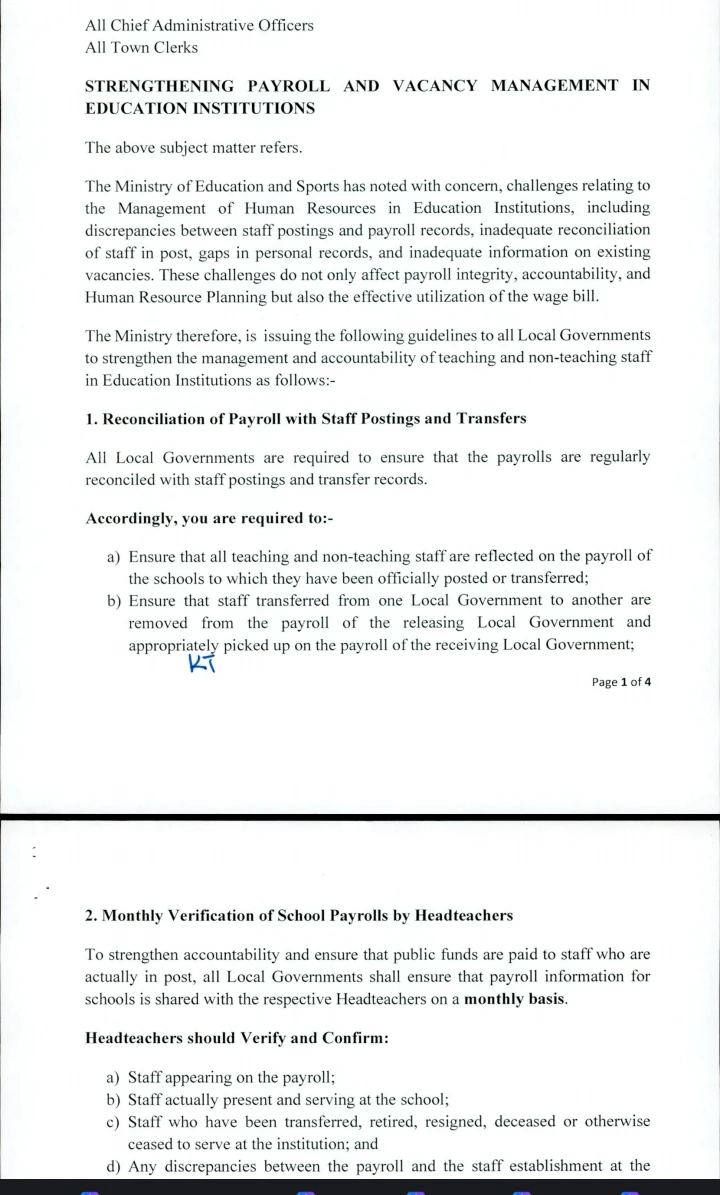
In a directive signed by the Ministry’s Permanent Secretary, Dr. Kedrace Turyagyenda, Local Governments have been instructed to reconcile school payrolls with staff postings, conduct monthly verification of payrolls with headteachers, maintain duplicate personnel files and establish the actual number and cost of vacant positions in primary schools, secondary schools and decentralised tertiary institutions.

The Ministry of Education and Sports has directed all Chief Administrative Officers (CAOs) and Town Clerks across Uganda to strengthen payroll management, verify staffing gaps and improve accountability in public education institutions amid concerns over discrepancies in staff records, transfers and vacant positions.
In a directive signed by the Ministry’s Permanent Secretary, Dr. Kedrace Turyagyenda, Local Governments have been instructed to reconcile school payrolls with staff postings, conduct monthly verification of payrolls with headteachers, maintain duplicate personnel files and establish the actual number and cost of vacant positions in primary schools, secondary schools and decentralised tertiary institutions.
The measures are intended to improve payroll integrity, strengthen human resource planning and ensure effective utilisation of the government wage bill allocated to the education sector.
Under the directive, Local Governments are required to submit a consolidated report detailing verified and costed vacancies to the Ministry by November 6, 2026, to guide decisions on the wage provisions needed to fill critical staffing gaps across the three levels of education.
Monthly payroll verification ordered
Dr. Turyagyenda said the Ministry had noted challenges in human resource management within education institutions, including discrepancies between staff postings and payroll records, inadequate reconciliation of staff in post, incomplete personal records and insufficient information on existing vacancies.
The Ministry warned that these shortcomings undermine payroll accountability, human resource planning and the effective utilisation of public funds.
To address the problem, Local Governments must regularly reconcile payroll records with official staff postings and transfer information to ensure that teachers and non-teaching personnel are paid through the appropriate institutions.
Staff transferred from one Local Government to another must be removed from the payroll of the releasing authority and appropriately included on the payroll of the receiving Local Government.
The directive is intended to improve coordination between Local Governments and minimise inconsistencies that can arise when staff transfers are not promptly reflected in payroll systems.
The Ministry has also instructed Local Governments to share school payroll information with respective headteachers every month for verification.
Headteachers will be required to confirm the names of staff appearing on the payroll, establish whether the individuals are physically present and serving at their respective schools, and identify personnel who have been transferred, retired, resigned, died or otherwise ceased to work at the institutions.
Any discrepancies between payroll records and the actual staffing position must be reported promptly to the relevant Local Government offices for corrective action. The Ministry of Education and Sports may also be copied in the communication.
Local Governments to maintain duplicate staff files
The directive further requires every Local Government to establish and maintain duplicate physical personal files for all teaching and non-teaching staff posted to schools and other education institutions within its jurisdiction.
Although the Ministry remains the custodian of personal files for decentralised teaching and non-teaching staff in secondary schools and other decentralised education institutions, the additional records at Local Government level are intended to facilitate verification, accountability and effective personnel management.
The duplicate files should contain relevant employment and personnel documents, including information on staff postings and transfers.
Where an employee is transferred to another Local Government, the duplicate personal file must be forwarded to the receiving authority alongside the employee’s last pay certificate to ensure continuity and completeness of personnel records.
The arrangement is expected to help Local Governments track staff movements more effectively and maintain reliable records for administrative and payroll management.
Recruitment plans and budgets due by October 30
Dr. Turyagyenda also reminded Local Governments that planning and budgeting for secondary schools and decentralised tertiary institutions fall under the responsibility of their respective Accounting Officers.
Consequently, Local Governments must prepare recruitment plans and budgets for the subsequent financial year at the beginning of the budgeting cycle.
The plans should indicate the staff currently in post and identify staffing gaps that need to be filled during the next financial year.
According to the directive, these plans will guide submissions for recruitment clearance and help the relevant authorities determine the personnel requirements of education institutions.
All Local Governments have been instructed to submit their recruitment plans and budgets to the Ministry of Education and Sports by October 30 every year.
The requirement places responsibility on Local Government Accounting Officers to ensure that recruitment proposals are supported by clear staffing assessments and budget projections.
Local Governments reminded of disciplinary responsibilities
The Permanent Secretary also clarified the responsibilities of Local Governments in handling disciplinary matters involving staff in secondary schools and decentralised tertiary institutions.
The directive refers to Circular Standing Instruction No. 1 of 2020, under which enforcement of the Public Service Code of Conduct regulations was decentralised, and Established Notice No. 3 of 2026 issued by the Ministry of Public Service.
Under the arrangements outlined in the notice, the management of discipline and performance, including the recognition and rewarding of exceptional performance, rests with the respective Local Government Rewards and Sanctions Committee.
Where a disciplinary matter requires further action by the Ministry of Education and Sports or the Education Service Commission, the responsible officers must prepare complete case files and submit them to the Permanent Secretary.
The submissions must include specific recommendations from the Rewards and Sanctions Committee indicating the action required.
The requirement is intended to ensure that cases referred to central authorities are properly documented and supported by clear recommendations, reducing delays in the handling of disciplinary matters.
Audit of vacancies and wage requirements
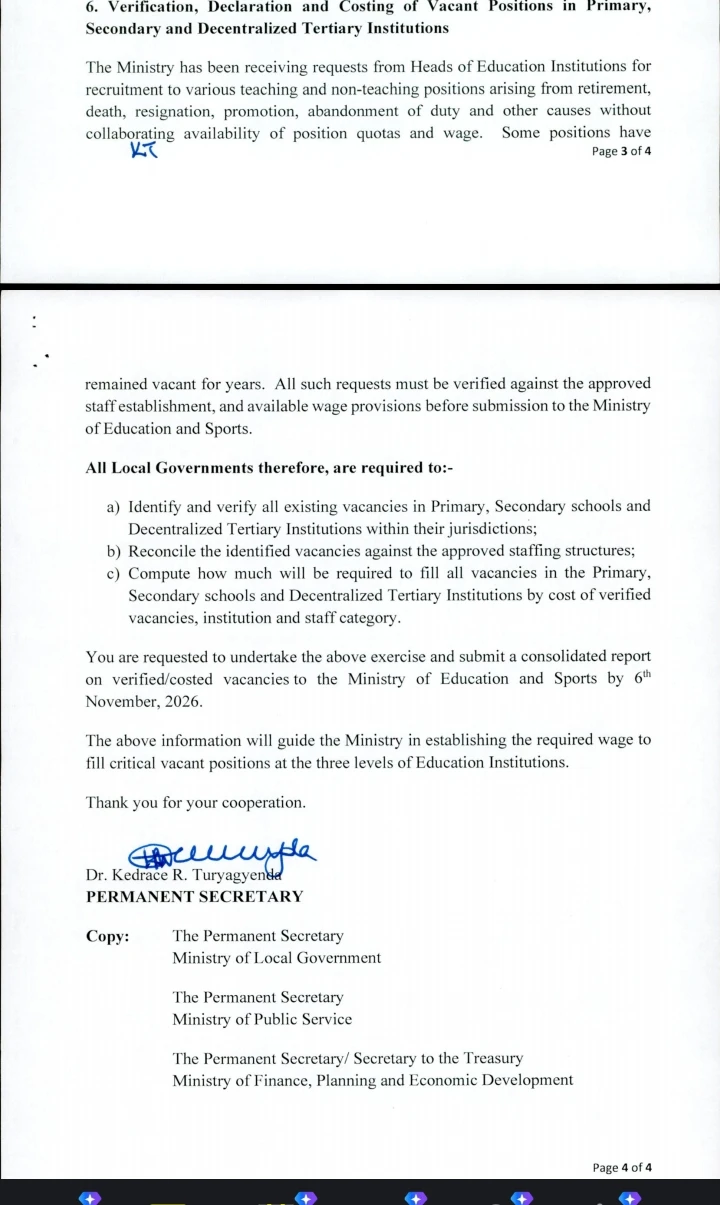
A major component of the directive concerns the verification and costing of vacant positions in primary schools, secondary schools and decentralised tertiary institutions.
Dr. Turyagyenda said the Ministry had been receiving recruitment requests from heads of education institutions to fill positions arising from retirement, death, resignation, promotion, abandonment of duty and other circumstances, without sufficient confirmation of the availability of approved staff positions and corresponding wage provisions.
The Ministry also noted that some positions had remained vacant for years.
To address the challenge, Local Governments have been directed to identify and verify all existing vacancies in education institutions within their jurisdictions and reconcile them against approved staffing structures.
They must also calculate the financial requirements for filling the verified vacancies, with the costs broken down by institution and staff category.
The exercise is expected to give the Ministry a clearer picture of the number of vacant positions, the distribution of staffing gaps and the wage resources required to recruit additional personnel.
Local Governments must submit the consolidated report on verified and costed vacancies by November 6, 2026.
The Ministry will use the information to determine the wage requirements for filling critical vacant positions across primary, secondary and decentralised tertiary education institutions.
Implications for education service delivery
The directive places Local Governments at the centre of efforts to improve human resource management and accountability in public education institutions.
Regular payroll reconciliation, monthly verification by headteachers and the maintenance of personnel files could help authorities identify inconsistencies between official records and the actual staffing position at schools.
The vacancy verification exercise could also provide a more reliable basis for planning recruitment, budgeting for salaries and prioritising institutions with critical staffing gaps.
For education managers, the instructions introduce clear administrative responsibilities and reporting deadlines, particularly for recruitment planning and the identification of vacancies.
The emphasis on verifying positions against approved staffing structures and available wage provisions also signals that requests for recruitment must be supported by accurate records and credible budget assessments.
However, the effectiveness of the measures will depend on the ability of Local Governments and education institutions to maintain up-to-date records, coordinate staff transfers and complete the required verification exercises within the stipulated timelines.
The directive was copied to the Permanent Secretaries of the Ministry of Local Government, Ministry of Public Service, and the Ministry of Finance, Planning and Economic Development, underscoring the cross-government coordination required to strengthen staffing and wage management in the education sector.
Dr. Turyagyenda called for cooperation from all Local Governments in implementing the guidelines, which seek to improve accountability, strengthen workforce planning and ensure that public resources allocated to education are managed effectively.

John Kusolo is a Pastor, Sports Enthusiast and Ugandan journalist with Nile Chronicles News (NCN). With a strong commitment to journalistic excellence, he is recognized for his dedication, goal-oriented approach, and ability to thrive in challenging environments. Kusolo brings focused motivation and professionalism to his reporting and media assignments.

















Comments (0)