
Bugisu Cultural Institution Spokesperson Steven Masiga Rebuts Kiryowa Kiwanuka Over Umukuuka Tenure Opinion
In a detailed response issued in his personal capacity as spokesperson of the Umukuuka, Masiga argued that the Attorney General’s opinion misinterpreted the legal distinction between taking an oath and the lawful assumption of office by a traditional leader. He further questioned the legal weight of successive opinions from the Attorney General’s chambers and cautioned against interference in matters currently before court.
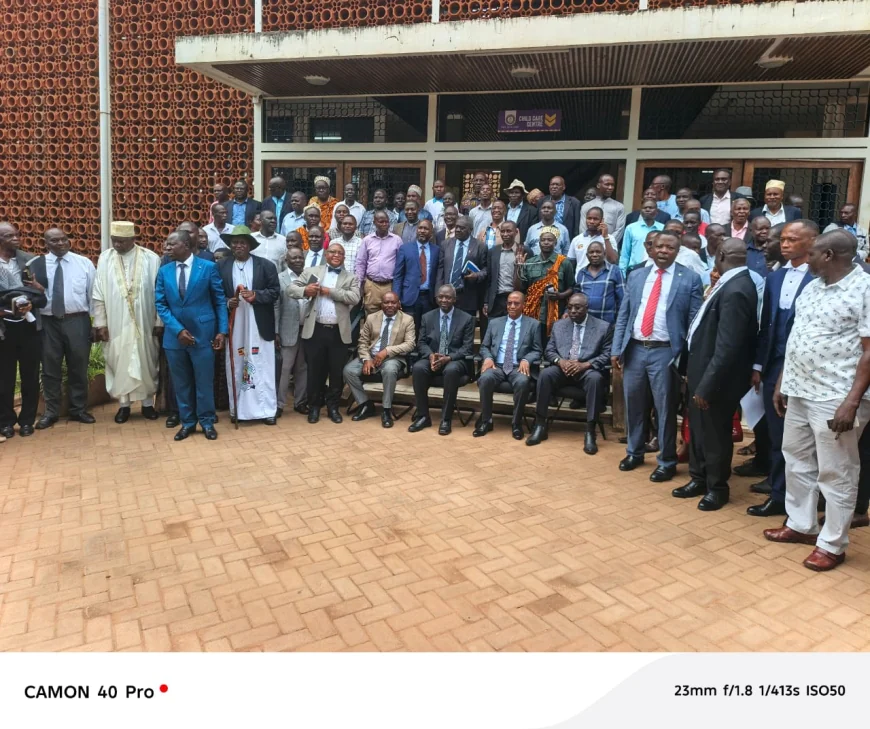
The spokesperson of the Bugisu Cultural Institution, Hon. Steven Masiga, has strongly rebutted a legal opinion issued by former Attorney General Hon. Kiryowa Kiwanuka concerning the tenure of the Umukuuka and the proposed alteration of the institution’s name from Inzu Ya Masaaba to Bugisu Cultural Institution.
In a detailed response issued in his personal capacity as spokesperson of the Umukuuka, Masiga argued that the Attorney General’s opinion misinterpreted the legal distinction between taking an oath and the lawful assumption of office by a traditional leader. He further questioned the legal weight of successive opinions from the Attorney General’s chambers and cautioned against interference in matters currently before court.
Masiga described his statement as a rebuttal to the Attorney General’s guidance, emphasizing that the issues surrounding the Umukuuka’s office remain subject to judicial determination.
Distinction Between Oath Taking and Assumption of Office
Masiga argued that the Attorney General’s opinion appeared to conflate the act of taking an oath with the actual legal assumption of office.
“With respect, the learned Attorney General’s guidance appears to conflate the act of taking an oath with the legal effect of assuming office. The mere administration of an oath does not, by itself, confer office or legal capacity,” Masiga stated.
To support his argument, he referenced the case of Jude Mike Mudoma v. Attorney General, explaining that although Jude Mike Mudoma had been elected and sworn in as Umukuuka of Inzu Ya Masaaba, he was unable to assume office before completion of the statutory gazettement process.

Masiga noted that Justice Apiny directed the parties to resolve the matter under Article 16(1) and (2) of the Institution of Traditional and Cultural Leaders Act, 2011, effectively rendering the earlier oath legally inoperative until all legal procedures had been completed.
He further drew comparison with the 1917 American case of John Hylan v. City of New York, where an elected official was reportedly prevented from assuming office despite winning the election because of pending legal issues.
Attorney General Opinions Are Coordinate, Not Hierarchical
Masiga also challenged the notion that a later opinion from the Office of the Attorney General automatically overrides earlier guidance on the same subject.
He argued that opinions issued by the Attorney General are “coordinate, not hierarchical,” unlike Supreme Court decisions which bind lower courts through the doctrine of stare decisis.
“It follows that a later opinion cannot, by mere issuance, displace an earlier one unless it is grounded in superior legal authority or a change in law,” he stated.
The spokesperson maintained that previous opinions issued by the Attorney General’s office regarding the Umukuuka’s status should therefore not be disregarded without clear constitutional or statutory justification.
Warning Against Interference in Court Matters
Masiga further invoked Article 128 of the Constitution of Uganda, which guarantees judicial independence and bars interference in court proceedings.
According to him, the issues currently being addressed in the Attorney General’s opinion are already before the High Court in Mbale and are therefore sub judice.
“We urge the Office of the Attorney General to remain mindful of Article 128 of the Constitution of Uganda, which safeguards the independence of the judiciary and prohibits any person or authority from interfering with court processes,” he said.
Masiga disclosed that he had personally participated in the court proceedings on behalf of the Umukuuka’s team and confirmed that the prayers sought from the Attorney General were identical to those pending before court.
He further argued that after previously issuing guidance on the corrigendum and related matters, the Attorney General’s office had become functus officio on those questions.
According to Masiga, issuing additional opinions on the same dispute risks being interpreted as an attempt to influence or preempt judicial proceedings.
Dispute Over the Name of the Cultural Institution
A major aspect of Masiga’s rebuttal centered on the proposal to alter the name of the institution from Inzu Ya Masaaba to Bugisu Cultural Institution.
Masiga maintained that the identity of the region and community has long been constitutionally and historically recognized as Bugisu and Bagisu respectively.
“It is a settled constitutional and historical position, spanning over 124 years, that the region in question is Bugisu,” he stated.
He cited the 1902 Orders in Council as well as successive constitutional instruments of 1962, 1966, 1967, and 1995 as evidence supporting that position.
Masiga further referenced Article 10(a) of the Constitution of Uganda and Schedule 3, Item 10, which recognize the Bagisu as one of Uganda’s indigenous communities.
According to him, the recent opinion suggesting otherwise departs from both historical and constitutional realities.
He also criticized the opinion for allegedly lacking a firm statutory or constitutional foundation, arguing that “Bamasaba” does not appear as a legally recognized community in Ugandan law books.
Quoting the English case of Errington v. Errington, Masiga argued that anything purporting to be law must have a basis in written law.
“On a conservative reading of Ugandan law, ‘Bamasaba’ does not appear as a recognized community in the law books. The recognized entity is Bugisu/Bagisu,” he asserted.
Call for Judicial Resolution
Masiga concluded by insisting that all questions concerning the Umukuuka’s assumption of office, the legal effect of oaths, and the naming of the cultural institution should ultimately be resolved through the courts and existing legal frameworks rather than through administrative opinions.
“For the foregoing reasons, I submit that the matter of assumption of office, the effect of oaths, and the proper name of the institution are matters governed by existing law and pending judicial determination. They ought to be resolved within that framework, without prejudgment,” he concluded.
The response adds another layer to the ongoing legal and cultural debate surrounding the leadership and identity of the Bugisu Cultural Institution, a matter that continues to attract significant public and legal attention within the Bugisu sub-region and beyond.

John Kusolo is a Pastor, Sports Enthusiast and Ugandan journalist with Nile Chronicles News (NCN). With a strong commitment to journalistic excellence, he is recognized for his dedication, goal-oriented approach, and ability to thrive in challenging environments. Kusolo brings focused motivation and professionalism to his reporting and media assignments.











Comments (0)