
Dr. Samuel Watulatsu Calls for Urgent School Tour Reforms Following Kapchorwa Tragedy
Dr. Samuel W. Watulatsu, a renowned critical analyst, has called on the Government of Uganda to institute sweeping reforms governing school tours and educational trips following the tragic road accident in Kapchorwa District that claimed the lives of 21 pupils from King David Junior School in Ndejje.
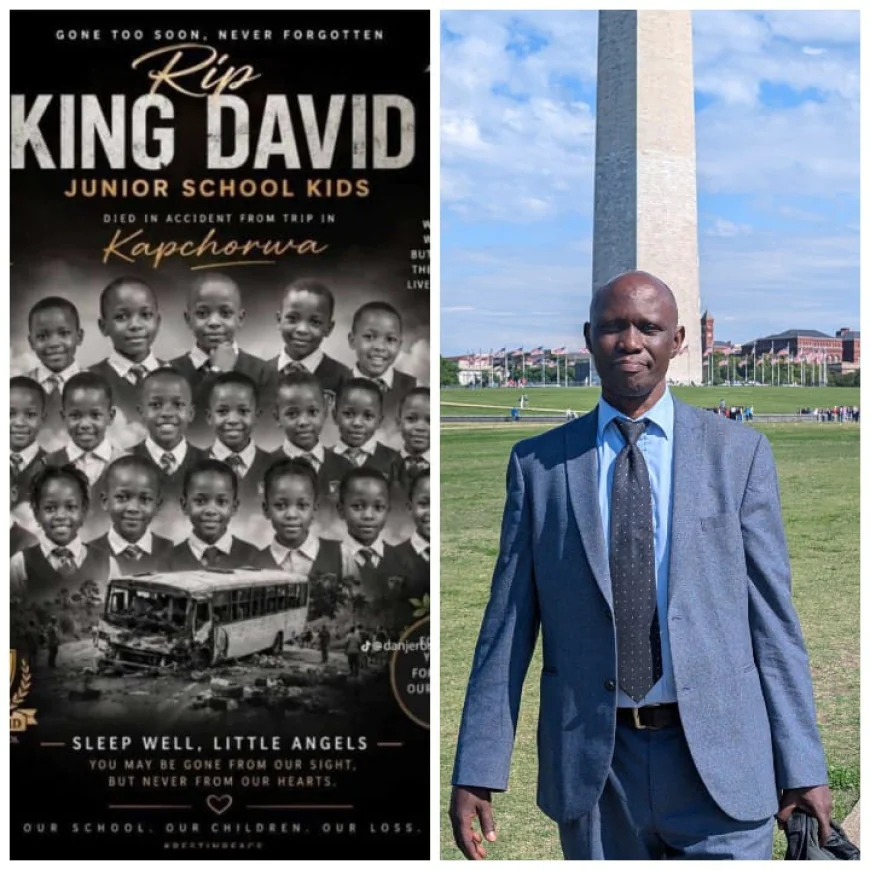
Mbale, Uganda: Dr. Samuel W. Watulatsu, a renowned critical analyst, has called on the Government of Uganda to institute sweeping reforms governing school tours and educational trips following the tragic road accident in Kapchorwa District that claimed the lives of 21 pupils from King David Junior School in Ndejje.
The devastating accident occurred at approximately 8:00 p.m. on Thursday, July 16, 2026, at Chekwatit Village in Kapchorwa District when a bus carrying the pupils crashed, leaving the nation in mourning and raising fresh concerns about the safety of school excursions.
Expressing his condolences, Dr. Watulatsu said the tragedy has once again exposed serious gaps in the regulation of school trips and the safety of learners.
"Losing 21 pupils along the Kapchorwa road is heartbreaking. The government should not wait for blood before it acts. What happened in Kapchorwa must be the last sacrifice, and it is high time government turns this pain into policy," he said.
He noted that the Kapchorwa tragedy comes barely a week after another serious accident involving students from Mwebaze High School in Kakiri, Wakiso District. On July 10, 2026, a school bus carrying students attempted to cross the Namumira-Bukasa railway crossing on Katosi Road in Mukono District and was struck by an oncoming passenger train. There have also been reports of another accident involving schoolchildren in Mityana, further highlighting the risks associated with student transportation.
According to Dr. Watulatsu, many Ugandans attained education and became successful without participating in school tours, arguing that discipline, quality teaching and parental guidance played a bigger role in shaping learners than frequent educational trips.
He further contended that some school excursions have shifted from educational activities to profit-making ventures disguised as learning opportunities.
"Many of these trips are not necessarily about learning. They are about money. Because they are often made mandatory within local school arrangements, children and parents have no choice but to participate," he observed.
Proposed Policy Reforms
Dr. Watulatsu has proposed a number of immediate interventions aimed at preventing future tragedies and restoring accountability in the education sector.
He called for a total ban on non-curricular school trips, arguing that only excursions directly linked to the national syllabus and approved by education authorities should be permitted.
He also proposed a Ministerial Approval Protocol, requiring every school trip to receive written approval from the Ministry of Education and Sports and district education authorities at least 30 days before departure. Under the proposal, head teachers who proceed without authorization would be held personally liable.
The analyst further advocated for an Accident Liability Law that would make schools and tour companies jointly responsible for the safety of learners. He said comprehensive insurance cover should be mandatory before any trip is approved.
Government-Parent-School Consent Framework
Dr. Watulatsu has also proposed the introduction of a standardized Government-Parent-School Consent Form to enhance transparency and accountability.
The form would require schools to clearly state:
The educational purpose of the trip and its direct connection to the curriculum;
A detailed cost breakdown, including transport, food, insurance and other charges;
Vehicle registration details, driver qualifications and proof of roadworthiness;
A comprehensive safety plan, including emergency contacts and access to nearby health facilities;
An opt-out clause ensuring that learners who do not participate are not punished academically.
He further recommended that the consent form be signed by parents or guardians, the head teacher and the District Education Officer or school inspector. Any trip conducted without the required approvals would be deemed illegal.
Strengthening Community and Parental Oversight
The education analyst also wants learning opportunities to be brought directly to schools through videos, virtual lessons, guest resource persons and mobile museum exhibitions to reduce unnecessary travel.
He further proposed granting Parent-Teacher Associations (PTAs) veto powers over school trips, requiring a two-thirds majority approval before any excursion is undertaken.
Additionally, he called for an outright ban on profit-making from school tours and urged government auditors to investigate schools that compel parents to contribute money for trips.
"If money is collected, it should be banked in official school accounts and properly accounted for, not handled privately," he said.
Support for Victims
Dr. Watulatsu also advocated for the establishment of a Counselling and Compensation Fund for victims of school-related accidents, arguing that bereaved families should not be forced to organize fundraising drives after suffering such devastating losses.
He urged schools to comply with the government's recent directive suspending all school tours until comprehensive guidelines are developed and enforced.
A Lasting Memorial
As the country mourns the 21 pupils who lost their lives, Dr. Watulatsu has proposed that any new school safety framework be named in honour of the victims of the King David Junior School tragedy.
"We hope that this tragedy becomes the last. The government should name the new policy after these children so that Uganda never forgets the painful lesson and remains committed to protecting learners," he said.
The Kapchorwa tragedy has reignited national debate on the regulation of school trips and learner safety, with education stakeholders, parents and policymakers now facing increasing pressure to implement lasting reforms that will prevent similar incidents in the future.

John Kusolo is a Pastor, Sports Enthusiast and Ugandan journalist with Nile Chronicles News (NCN). With a strong commitment to journalistic excellence, he is recognized for his dedication, goal-oriented approach, and ability to thrive in challenging environments. Kusolo brings focused motivation and professionalism to his reporting and media assignments.






Comments (0)