
NOGAMU CEO: Uganda’s Organic Expo to Open African Farmers to Global Markets
NOGAMU CEO Dr Chariton Namuwoza says Uganda’s November 2026 Organic and Nature Expo will connect African farmers to global markets, investors and sustainable farming technologies.
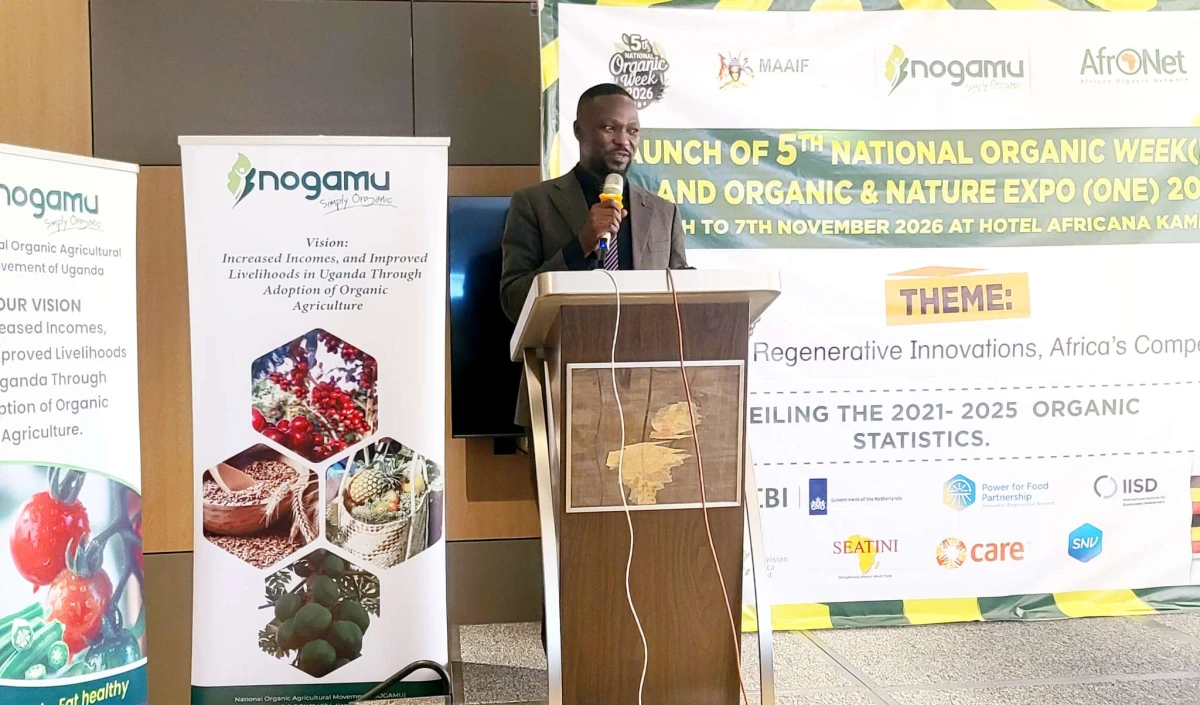
KAMPALA — Uganda is preparing to host the 5th National Organic Week and Africa’s first Organic and Nature Expo from November 4–7, 2026, in a move aimed at expanding market access for African organic producers, attracting investment and promoting sustainable agricultural practices.
The four-day event, organised by the National Organic Agricultural Movement of Uganda (NOGAMU), will take place at Hotel Africana in Kampala under the theme “Organic and Regenerative Innovations, Africa’s Competitive Edge.”
It is expected to bring together farmers, processors, exporters, buyers, investors, policymakers, certification bodies, financial institutions and development partners from Africa and beyond.
Addressing journalists in Kampala, NOGAMU Chief Executive Officer Dr Chariton Namuwoza said the expo was designed to connect agricultural producers with buyers and create opportunities for African businesses to compete in regional and international markets.
“We conceived the Organic and Nature Expo as a platform for bringing together the different actors the farmers or producers, the traders, the processors, but also buyers, and not only buyers from Uganda or Africa, buyers from Europe,” Namuwoza said.
He expressed confidence in Africa’s growing capacity to participate in international organic trade, emphasising the importance of strengthening business relationships and market connections across the continent.
“I can proudly say at this moment that Africa is ready to engage on the front of organic trade at the continental level, and the whole world is gathering in Uganda,” he said.
The event will combine exhibitions, policy discussions, business to business meetings, practical training and field visits to showcase opportunities within organic and regenerative agriculture.
Organisers expect more than 2,000 stakeholders to participate, providing a platform for agricultural enterprises to display products, identify potential buyers, explore financing options and establish partnerships with organisations supporting sustainable food systems.
Four Days of Trade, Innovation and Practical Learning
The programme will feature different activities each day, with discussions focusing on trade, agricultural standards, sustainable production, value addition and renewable-energy solutions.
The opening day will focus on policy engagement, exhibitions, regional trade and the promotion of standards that can improve confidence in organic products.
Participants are expected to discuss the East African Organic Product Standard and the Kilimo Hai Green Mark, which supports the identification and promotion of organic products. Kenya’s Kilimo Hai Blue Mark, associated with agroecological production, will also feature in discussions on sustainable farming approaches.
The second day will focus on organic and regenerative agriculture, including soil health, agroforestry, market access and practical farming techniques. Business-to-business engagements are expected to connect producers with buyers, processors, exporters and potential investors.
The third day will be dedicated to regenerative coffee, with activities including coffee tasting and discussions on opportunities to strengthen sustainable coffee production and improve the competitiveness of African coffee in international markets.
The final day will feature farm excursions designed to give participants practical exposure to farmers and enterprises applying organic and regenerative methods.
The visits are expected to showcase technologies such as biogas digesters, solar-powered irrigation, solar drying and renewable energy powered cooling systems, demonstrating how clean energy can support production, processing and post-harvest management.
The programme will cover agricultural value chains including coffee, bananas, poultry and dairy.
Renewable Energy and Agricultural Value Addition
A key feature of the event will be the connection between regenerative agriculture and the productive use of renewable energy.
The approach seeks to demonstrate how technologies such as solar irrigation, solar dryers, cold storage and renewable-powered processing can help farmers and agribusinesses improve productivity, reduce post-harvest losses and add value to their products.
NOGAMU’s event communications describe the RA-PURE Village as a platform for connecting regenerative agriculture with practical renewable-energy solutions, including irrigation, drying, cooling and biogas technologies.
For smallholder farmers and agricultural businesses, access to such technologies can be important in managing production costs, preserving produce and preparing products for higher value markets.
The expo is also expected to provide opportunities for financial institutions, technology providers and development partners to engage directly with farmers and agribusinesses seeking practical solutions to challenges along the agricultural value chain.
Women and young people are among the groups expected to benefit from the business, networking and innovation opportunities available during the event.
Uganda’s Organic Agriculture Agenda
The event will also provide an opportunity to assess progress in Uganda’s organic agriculture sector and discuss the policies, financing and market infrastructure needed to strengthen its growth.
Government approved Uganda’s National Organic Agriculture Policy in 2019, establishing a policy framework for the development of the sector. Organisers intend to use the gathering to reflect on progress since the policy’s adoption and identify areas requiring further attention.
Organic agriculture places emphasis on production systems that avoid or restrict the use of synthetic agricultural inputs, in line with applicable organic standards.
Regenerative agriculture, meanwhile, focuses on improving soil health, supporting biodiversity and strengthening the long-term resilience of farming systems. Although the approaches can overlap, they are not identical, and organic certification requires compliance with specific standards.
For African producers seeking international markets, compliance with recognised standards and certification requirements remains important in building buyer confidence and meeting market expectations.
NOGAMU, the umbrella organisation for organic agriculture stakeholders in Uganda, promotes organic farming practices and works to connect producers with markets. Its annual National Organic Week provides a platform for exhibitions, farmer engagement, policy dialogue and business networking.
Through the 2026 edition, organisers hope to strengthen collaboration among farmers, businesses, governments and development partners while positioning Uganda as a meeting point for discussions on organic trade and sustainable agricultural innovation.

Benjamin Mwibo is a talented, passionate and creative journalist with a commitment to high quality out put that is factual and researched. Above all Dedicated with a strong desire to identify the truth of the matter.












Comments (0)