
Parliamentary Committee Inspects Philip Omondi Stadium, KCCA Seeks UGX 39.4 Billion to Complete Project and Install FIFA-Standard Turf
Led by Chairperson Alex Byarugaba, the committee toured the stadium site on Thursday to assess the progress of works and review the utilization of government funds already disbursed.
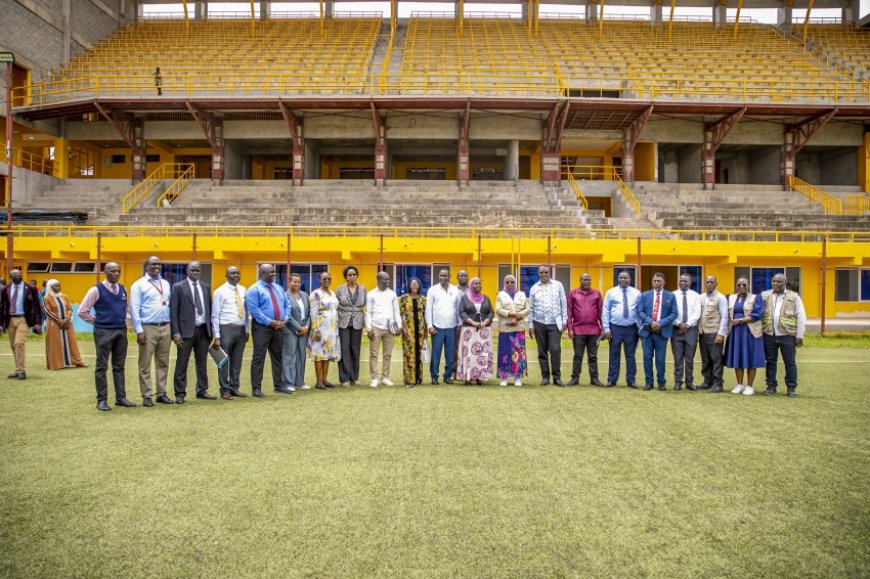
The Parliamentary Committee on Presidential Affairs has conducted an oversight visit to the Philip Omondi Stadium, currently under phased construction in Kampala, as the Kampala Capital City Authority (KCCA) formally appealed for additional funding to complete the facility and install a new FIFA-standard artificial turf.
Parliamentary Oversight and Accountability
Led by Chairperson Alex Byarugaba, the committee toured the stadium site on Thursday to assess the progress of works and review the utilization of government funds already disbursed.
“We are here to see what you are doing and how you are using the money,” Byarugaba stated, underscoring Parliament’s constitutional mandate to ensure accountability, transparency, and value for public investment in national infrastructure projects.
The visit forms part of Parliament’s broader oversight role in monitoring public spending, particularly on strategic projects with significant financial outlays.
Project Scope and Current Progress
The Philip Omondi Stadium is designed as a 10,000-seater multi-purpose sports facility being developed in phases. To date, the government has invested UGX 16 billion in the first two phases of construction, executed by Sarjan Construction.
Completed works include:
Primary spectator stands
Players’ and coaches’ dormitories
Foundational structural and support infrastructure
Despite this progress, KCCA officials informed the committee that a total of UGX 55 billion is required to fully complete the stadium to meet national and continental standards. This leaves a funding gap of approximately UGX 39.4 billion.
Urgent Need for a New Playing Surface
A key concern raised during the visit was the condition of the stadium’s artificial turf. Installed a decade ago, the surface officially expired in January 2026 and no longer meets safety and certification requirements.
KCCA is seeking UGX 3.7 billion to install a new FIFA-standard artificial turf, describing the replacement as mandatory for:
Player safety and welfare Compliance with international match regulations
Eligibility to host high-level domestic and continental fixtures
Officials emphasized that without the new turf, the stadium cannot stage competitive matches that require international certification.
Beyond the playing surface, several critical components remain incomplete before the facility can qualify for certification by the Confederation of African Football (CAF).
Pending works include:
Installation of modern floodlights
Mechanical and electrical systems
ICT infrastructure
Media center and press facilities
Accessibility features for persons with disabilities
Dining and kitchen facilities
Fully developed primary and secondary stands
Upon completion, the stadium is expected to host various teams and events, including national competitions and the Parliamentary Games, while serving more than 10,000 users.
Strategic Investment in Youth and Community Development
KCCA Executive Director Sharifah Buzeki highlighted the authority’s broader sports development agenda, noting that KCCA manages one of Uganda’s most successful football clubs, KCCA FC.
“We run the football club to enhance community development through sports and talent identification,” Buzeki said. “With more than 70 percent of Uganda’s population below the age of 30, this stadium is an investment in youth empowerment, employment and national pride.”
Minister for Kampala Capital City and Metropolitan Affairs Minsa Kabanda described the project as a strategic national investment with benefits extending beyond Kampala.
She emphasized that the stadium will serve as a hub for talent nurturing, sports tourism, and economic activity while strengthening Uganda’s capacity to host regional and continental competitions.
KCCA CEO Anisha Muhoozi noted that once completed, the multi-purpose facility will significantly boost Kampala’s sports infrastructure portfolio. The stadium is expected to meet modern standards, enhance accessibility, and position the city as a competitive host for major sporting events.
The committee’s findings and recommendations will inform Parliament’s decision on whether to approve the requested additional funding. As discussions continue, the future of Philip Omondi Stadium stands as a test case for balancing fiscal discipline with strategic investment in youth-centered infrastructure.
If fully funded and completed, the facility is poised to become a landmark sports complex and a cornerstone of Uganda’s football development agenda.

John Kusolo is a Pastor, Sports Enthusiast and Ugandan journalist with Nile Chronicles News (NCN). With a strong commitment to journalistic excellence, he is recognized for his dedication, goal-oriented approach, and ability to thrive in challenging environments. Kusolo brings focused motivation and professionalism to his reporting and media assignments.










Comments (0)