
Journalists Equipped with Investigative Tools to Expose Counterfeit and Substandard Goods
During Day Three of the capacity-building training held on 3rd March 2026 at Ridar Hotel, media practitioners received a detailed investigative playbook from Gerald Businge Ateenyi, Team Lead at Ultimate Multimedia Consult.
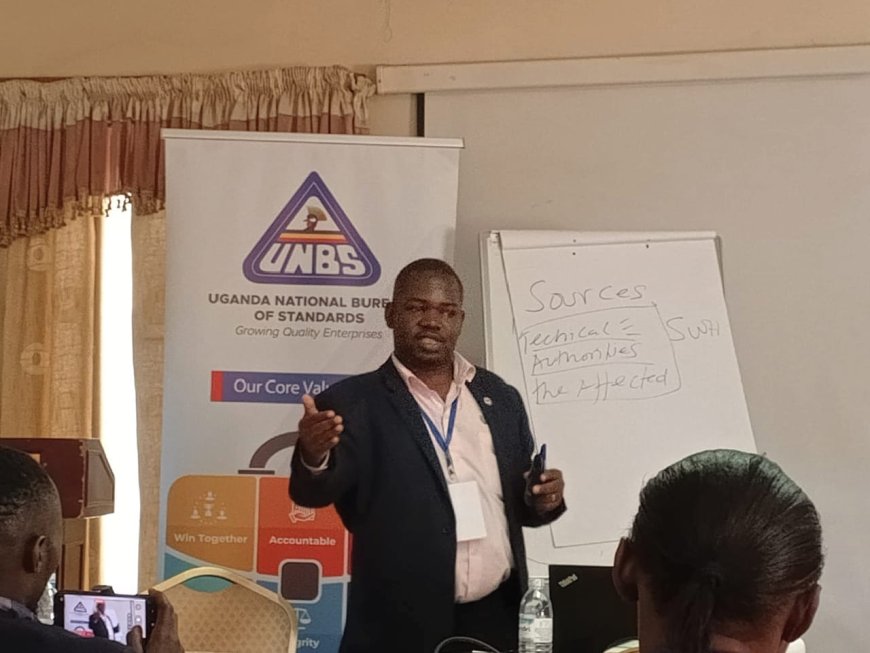
Journalists participating in the ongoing Media Training on Standards and Metrology Reporting have been equipped with practical investigative tools to expose counterfeit and substandard products circulating in Uganda’s markets.
During Day Three of the capacity-building training held on 3rd March 2026 at Ridar Hotel, media practitioners received a detailed investigative playbook from Gerald Businge Ateenyi, Team Lead at Ultimate Multimedia Consult.
The training forms part of a four-day programme organised by the Uganda National Bureau of Standards, in partnership with TradeMark Africa and funded by UK Aid, aimed at strengthening journalism around quality infrastructure, consumer protection, standards compliance, and product certification.
Counterfeit Trade: A Global Problem with Local Consequences
Businge opened his presentation by highlighting the scale of the global counterfeit crisis and its devastating impact on economies and public health.
Drawing from international statistics, he noted that counterfeit and pirated goods account for about 2.3 percent of global trade, according to the Organisation for Economic Co‑operation and Development.
In addition, he cited findings from the World Health Organization, which estimate that 10.5 percent of medical products in low- and middle-income countries fail quality standards, exposing millions of people to dangerous and ineffective medicines.
The economic consequences are equally severe, with substandard and falsified goods estimated to cause over 30 billion dollars in losses annually across developing economies.
"These fakes destroy economies and cost lives,” Businge told participants, emphasizing that journalists serve as the frontline defenders in exposing such illicit trade networks.
Understanding the Difference: Substandard vs Counterfeit
A key element of investigative reporting on product quality, Busingye explained, is understanding the legal distinction between substandard and counterfeit products.
Substandard products are legitimate goods that fail to meet required quality specifications due to manufacturing defects, poor storage, or degradation during transportation.
Counterfeit or falsified goods, however, involve deliberate criminal forgery, where products are intentionally misrepresented in identity, composition, or origin.
He warned journalists against misusing the term “counterfeit” in headlines when referring to substandard products, explaining that such errors could lead to costly defamation lawsuits against media houses.
“A genuine product can fail a strength test and become substandard, but it is not necessarily counterfeit,” he explained.
Investigating Certification Marks
One of the most practical parts of the training focused on how journalists can verify product certification marks issued by Uganda National Bureau of Standards.
Businge guided participants through what he called the “Distinctive Mark Deep-Dive,” focusing on identifying genuine certification marks from forged ones.
He explained that authentic products bearing the UNBS Quality Mark must display:
The interlocking “U” and “N” logo inside a gear-like circle
A clearly printed Uganda Standard (US) number linked to the specific product category
Accurate color and line patterns that match official designs
Any missing standard number or mismatched category — such as a cement standard appearing on a beverage bottle — is a strong indicator of forgery.
Verifying Products When Digital Tools Fail
Recognizing that journalists often work in environments where internet connectivity may be unreliable, Businge also outlined analogue verification methods.
These include:
Checking the Uganda Standard number printed below the certification mark
Using UNBS SMS or USSD verification services
Consulting the UNBS Directory of Certified Products on the Bureau’s website
Inspecting packaging for holograms, tamper-evident seals, and other security features
He also advised journalists to watch out for physical red flags, including blurred packaging text, spelling mistakes, reused batch numbers, inferior materials, and unusually low product prices.
“The ‘too good to be true’ price is often the first warning sign,” he said.
Tracking Counterfeits in Digital Markets
With the rapid growth of online commerce, Businge noted that counterfeiters are increasingly using digital platforms to sell fake goods.
Warning signs on e-commerce platforms include:
Websites lacking HTTPS security encryption
Sellers with no physical address or traceable contact details
Listings openly advertising “high imitation” products
Brand names applied to products that companies never manufacture
Such digital clues, he explained, can help journalists trace the supply chains behind counterfeit networks.
Following the Supply Chain
Businge encouraged investigative journalists to go beyond identifying fake goods on retail shelves and instead track how they enter the market.
Key investigation points include: Border entry points where counterfeit goods infiltrate supply chains
Wholesale distribution hubs where bulk goods are redistributed
Repackaging zones where counterfeiters imitate genuine brands
"Counterfeit investigations require tracing the supply chain, not just exposing the fake product,” he emphasized.
Safety and Ethics in Undercover Reporting
Because counterfeit rings are often controlled by organized criminal networks, Businge warned journalists to prioritize safety during investigations.
He advised reporters to:
Work in teams rather than alone
Share their location with editors
Maintain regular check-in schedules during field investigations
He also stressed that hidden cameras should only be used when the public interest clearly outweighs privacy concerns, such as in cases involving fake medicines or dangerous consumer products.
Reporting on UNBS Enforcement Operations
Businge also provided guidance on how journalists should cover enforcement operations conducted by Uganda National Bureau of Standards inspectors.
He cautioned that raid scenes are treated as active crime scenes, and mishandling evidence could compromise court cases.
Journalists were advised to:
Do:
Observe from a safe distance
Document the scale of the operation
Wait for official statements from UNBS
Don’t:
Interfere with inspectors
Touch unverified products
Publish official documents prematurely
Protecting Legal Evidence
One of the most critical warnings involved the chain of custody for seized goods.
Businge explained that journalists should never handle or point at suspected counterfeit products before they are officially tagged by inspectors.
Photographs showing journalists interacting with unverified evidence could be used by defense lawyers in court to argue that evidence was tampered with by unauthorized civilians.
Similarly, sensitive documents such as Seizure Forms and Premises Inspection Forms should only be published after clearance from the Bureau, with personal details and signatures redacted.
Empowering Journalists to Protect Consumers
The training concluded with a practical investigative checklist designed to guide journalists when reporting on product quality issues.
The checklist encourages reporters to:
Verify certification marks and standard numbers
Track suspicious pricing patterns and duplicate batch numbers
Respect the chain of custody during enforcement operations
Use legally accurate terminology when reporting on substandard or counterfeit goods
Businge emphasized that well-informed journalism plays a critical role in protecting consumers, supporting regulatory enforcement, and holding counterfeit networks accountable.
“As journalists, your investigations can save lives by exposing dangerous products and protecting the integrity of Uganda’s markets,” he told participants.
The training continues until 4th March 2026, with journalists expected to develop investigative story ideas on standards, quality assurance, and consumer protection in Uganda.

John Kusolo is a Pastor, Sports Enthusiast and Ugandan journalist with Nile Chronicles News (NCN). With a strong commitment to journalistic excellence, he is recognized for his dedication, goal-oriented approach, and ability to thrive in challenging environments. Kusolo brings focused motivation and professionalism to his reporting and media assignments.
















Comments (0)