
President Museveni Unveils “No More Sleep” Agenda in Sweeping Inaugural Address
Addressing visiting Heads of State, government officials, and Ugandans from across the country, Museveni described the new five-year term as a “Kisanja of no more sleep,” urging citizens to actively participate in wealth creation by utilizing government programs and Uganda’s economic opportunities.
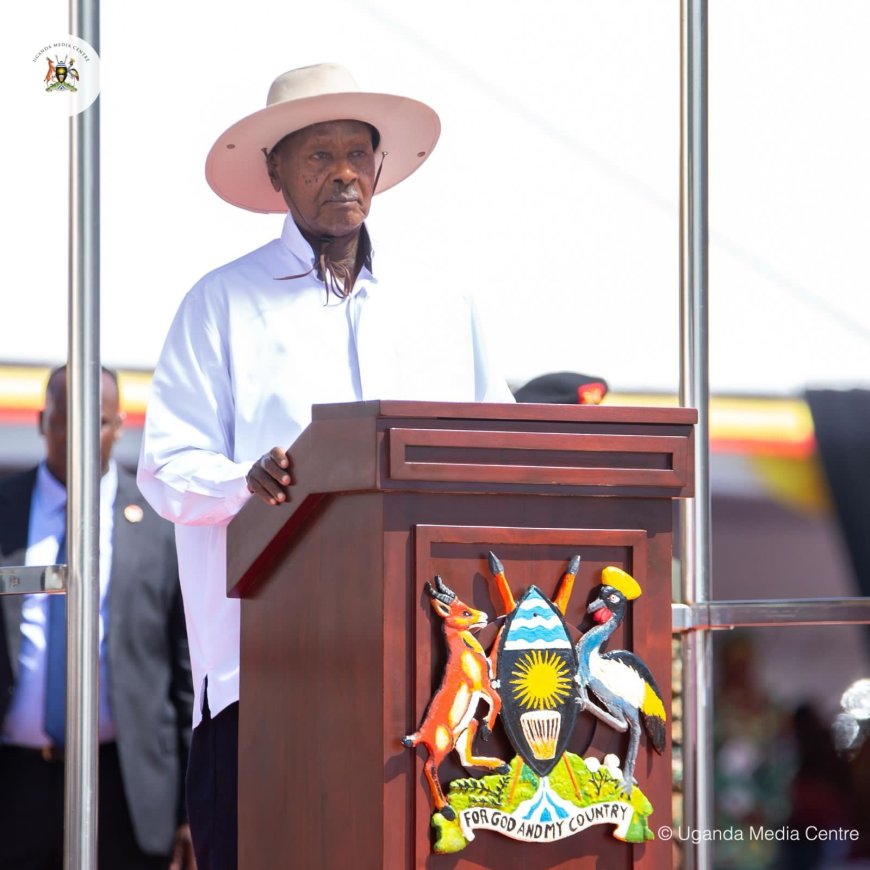
Ugandan President Yoweri Kaguta Museveni used his 2026 swearing-in speech at Kololo Ceremonial Grounds to outline an ambitious economic transformation agenda centered on wealth creation, job generation, industrialization, and regional integration, while also defending the National Resistance Movement’s (NRM) four-decade record in power.
Addressing visiting Heads of State, government officials, and Ugandans from across the country, Museveni described the new five-year term as a “Kisanja of no more sleep,” urging citizens to actively participate in wealth creation by utilizing government programs and Uganda’s economic opportunities.
The President congratulated Ugandans for participating in the January 2026 elections, praising the NRM for securing what he called decisive victories at presidential, parliamentary, and local government levels. He also commended opposition parties such as the Democratic Party (DP) and Uganda People’s Congress (UPC) for participating peacefully, while criticizing elements within the National Unity Platform (NUP) and Forum for Democratic Change (FDC) whom he accused of using violence during the electoral process.
Museveni devoted a significant portion of his speech to defending the NRM’s legacy since taking power in 1986. He pointed to Uganda’s transformation in infrastructure, peace, and urban development, citing the growth of Kampala’s real estate sector, road networks, electricity expansion, piped water systems, railways, airports, and telecommunications as evidence of progress under his leadership.
The President outlined what he termed the “matafaari” or building blocks the NRM has laid for Uganda over the past 40 years. These include peace and security maintained by the UPDF, economic and social infrastructure development, expansion of markets, improved service delivery, and policies aimed at promoting wealth creation among households and businesses.
Museveni emphasized that government initiatives such as the Parish Development Model (PDM), Emyooga, Uganda Development Bank financing, and Operation Wealth Creation were intended to provide citizens with access to affordable capital and production inputs. He challenged Ugandans to seize these opportunities and participate more actively in commercial agriculture, manufacturing, services, and ICT.
Highlighting examples of successful farmers and industrialists, Museveni referenced individuals such as Basangwa Johnson of Kamuli, Ijala Joseph of Serere, and farmer Nyakaana of Fort Portal, whom he said had demonstrated how small-scale commercial agriculture could generate substantial incomes and employment opportunities.
The President argued that Uganda’s 40 million acres of arable land could become a major engine for job creation if properly utilized. According to Museveni, adopting intensive agricultural models across seven million acres alone could create over 100 million jobs in small-scale commercial agriculture.
He further noted that employment opportunities were expanding across Uganda’s economy, from manufacturing industries such as the Madhvani Group in Kakira to service sector establishments including hotels like Sheraton Kampala Hotel and Speke Resort Munyonyo.
Museveni also highlighted Uganda’s growing pool of highly skilled professionals working on major infrastructure and industrial projects, including hydroelectric dams and automobile manufacturing initiatives such as Kiira Motors Corporation. He said the country’s transformation required both low-skilled and high-skilled labor, while calling for reforms in the education sector to prioritize practical and market-oriented skills.
On industrialization and value addition, the President strongly criticized the continued export of raw materials from African countries, describing it as a “strategic blunder” that deprives the continent of jobs and wealth. Using gold exports as an example, he argued that refining minerals locally significantly increases value and creates employment opportunities.
Museveni called for greater economic integration across Africa through regional blocs such as the East African Community (EAC), COMESA, and the African Continental Free Trade Area (AfCFTA). He maintained that Africa’s economy remained underdeveloped despite the continent’s vast resources and population, partly due to limited industrialization and continued dependence on exporting raw materials.
The President further pledged continued government support for agriculture, particularly through irrigation, fish farming, and solar-powered water systems aimed at boosting productivity at household and village levels. He praised Ntungamo Woman MP Hon. Joselyn Kamateneti for developing low-cost village water access models powered by solar energy.
Environmental conservation also featured prominently in the address, with Museveni warning against wetland degradation, rice growing in swamps, and destruction of natural forests. He stressed the importance of preserving wetlands and forests for rainfall formation, irrigation, biodiversity, and protection of river catchment areas.
The President urged citizens to actively monitor and participate in Parish SACCOs to ensure accountability in government programs and prevent misuse of public funds. He also appealed to Members of Parliament to prioritize funding for the Parish Development Model to accelerate household income generation.
As he concluded his address, Museveni thanked visiting leaders and guests from across Africa and beyond for attending the ceremony, reaffirming Uganda’s commitment to peace, justice, and regional cooperation.
“God bless Africa. God bless Uganda. Let there be Peace and Justice in the World,” Museveni said at the close of his speech.

John Kusolo is a Pastor, Sports Enthusiast and Ugandan journalist with Nile Chronicles News (NCN). With a strong commitment to journalistic excellence, he is recognized for his dedication, goal-oriented approach, and ability to thrive in challenging environments. Kusolo brings focused motivation and professionalism to his reporting and media assignments.





Comments (0)