
Hon. Aisha Sekindi Calls for Nexus-Driven Water and Environmental Management at UWEWK 2026
The weeklong event, organized by the Ministry of Water and Environment at its headquarters in Luzira, is being held under the theme: “Water and Environment for an Inclusive and Prosperous Uganda.” According to Hon. Sekindi, the theme reflects Uganda’s natural aspirations for sustainable growth and socio-economic transformation.
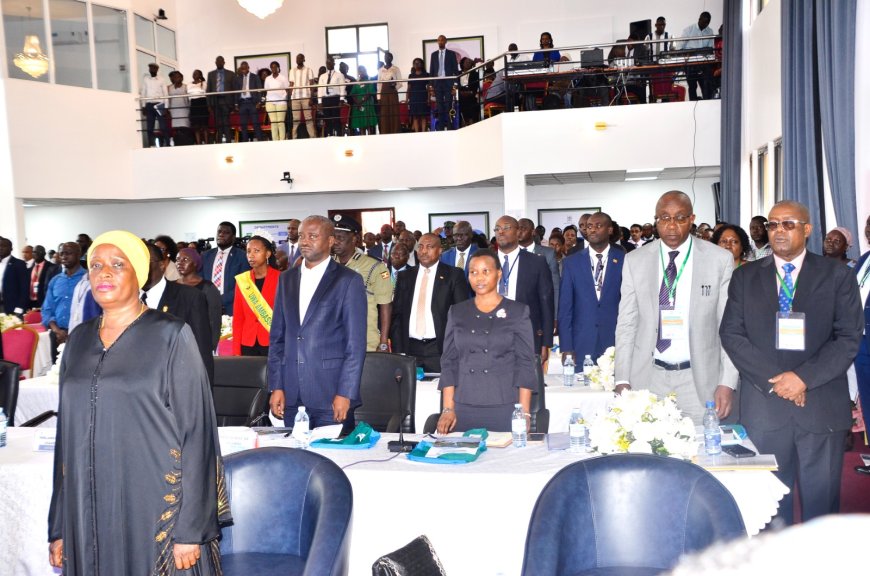
Kampala — The Minister of State for Water and Woman Member of Parliament for Kalungu District, Hon. Aisha Sekindi, has underscored the need for Uganda to transition from managing natural resources to optimizing them, as she delivered remarks at the opening ceremony of the Ninth Uganda Water and Environment Week (UWEWK) 2026.
The weeklong event, organized by the Ministry of Water and Environment at its headquarters in Luzira, is being held under the theme: “Water and Environment for an Inclusive and Prosperous Uganda.” According to Hon. Sekindi, the theme reflects Uganda’s natural aspirations for sustainable growth and socio-economic transformation.
“This event is where science, policy and community converge to talk about different issues,” she said, emphasizing that UWEWK provides a national platform for dialogue, innovation, and accountability in the stewardship of water and environmental resources.
A Critical Turning Point
Hon. Sekindi described the country as being at a pivotal moment in its development journey.
“We are at a critical juncture where we must transition from merely managing resources to optimizing them,” she noted, stressing that Uganda must maximize the economic, social, and environmental value of its water and natural assets.
She further explained that UWEWK is not an isolated engagement, but rather Uganda’s primary contribution to the continental development agenda under Africa Agenda 2063. By championing sustainable development and sound environmental governance, Uganda is positioning itself to help shape the Africa envisioned in the continental blueprint.
“We have to demonstrate to the continent and Uganda that through sustainable development and management of water and environmental resources, we can achieve the Africa and Uganda we want,” she said.
The Water-Energy-Food Nexus at the Core
Central to this year’s discussions is the “water-energy-food nexus” — an integrated approach that recognizes the interdependence of water resources, agricultural productivity, and energy generation.
Hon. Sekindi emphasized that Uganda cannot achieve inclusive and prosperous development in silos.
“Our national policies and strategies on food production are expanding irrigation to move away from rain-fed agriculture to help us secure the national food basket,” she said.
The Minister highlighted that irrigation expansion is critical to climate resilience and food security, particularly as Uganda faces increasingly unpredictable weather patterns. By reducing reliance on rainfall, the country aims to stabilize agricultural output and improve household incomes.
On energy production, she noted that Uganda’s hydropower dams depend heavily on healthy watersheds.
“Our power dams depend on watersheds; therefore, we need to secure them jealously,” she stressed, calling for enhanced watershed protection and restoration efforts to safeguard national energy security.
By adopting the nexus approach, Uganda is ensuring that every drop of water serves multiple pillars of the economy. Hon. Sekindi pointed to the development of multipurpose dams and the scaling up of solar irrigation schemes in rural areas as examples of integrated investments designed to support agriculture, energy access, and community livelihoods simultaneously.
From Policy to Practice
To ensure that UWEWK 2026 remains practical and impactful, Hon. Sekindi revealed that a series of activities have been planned to showcase policies in action.
Participants will witness integrated water resource management and wetland restoration initiatives, both of which are critical to maintaining ecological balance and sustaining water availability. Demonstrations on water harvesting — for both urban and rural supply systems — will also highlight innovative approaches to improving access to safe water.
The program further includes discussions on transboundary water cooperation with neighboring countries, reflecting Uganda’s commitment to regional collaboration in shared water resource management.
In addition, private sector actors will showcase how factories are achieving waste compliance standards and adopting greener production models, signaling growing corporate commitment to environmental sustainability.
Driving an Inclusive and Prosperous Uganda
Hon. Sekindi reiterated that inclusive prosperity requires coordinated planning and cross-sectoral collaboration. By aligning water management, energy production, and food systems under a unified framework, Uganda aims to build a resilient economy that supports industrial growth, rural transformation, and environmental conservation.
As UWEWK 2026 unfolds, the Minister expressed confidence that the deliberations and exhibitions will inspire actionable solutions, strengthen partnerships, and reinforce Uganda’s leadership in sustainable water and environmental governance both nationally and across the African continent.
The message from Luzira was clear: Uganda’s future prosperity will depend on how effectively it safeguards, integrates, and optimizes its water and environmental resources for generations to come.

John Kusolo is a Pastor, Sports Enthusiast and Ugandan journalist with Nile Chronicles News (NCN). With a strong commitment to journalistic excellence, he is recognized for his dedication, goal-oriented approach, and ability to thrive in challenging environments. Kusolo brings focused motivation and professionalism to his reporting and media assignments.










Comments (0)