
Ministry of Water and Environment Sets Stage for Ninth Uganda Water and Environment Week 2026
The estimated budget for UWEWK 2026 stands at UGX 1.2 billion, covering pre-event activities, conference logistics, international day commemorations, community engagements, innovation showcases and communication campaigns.
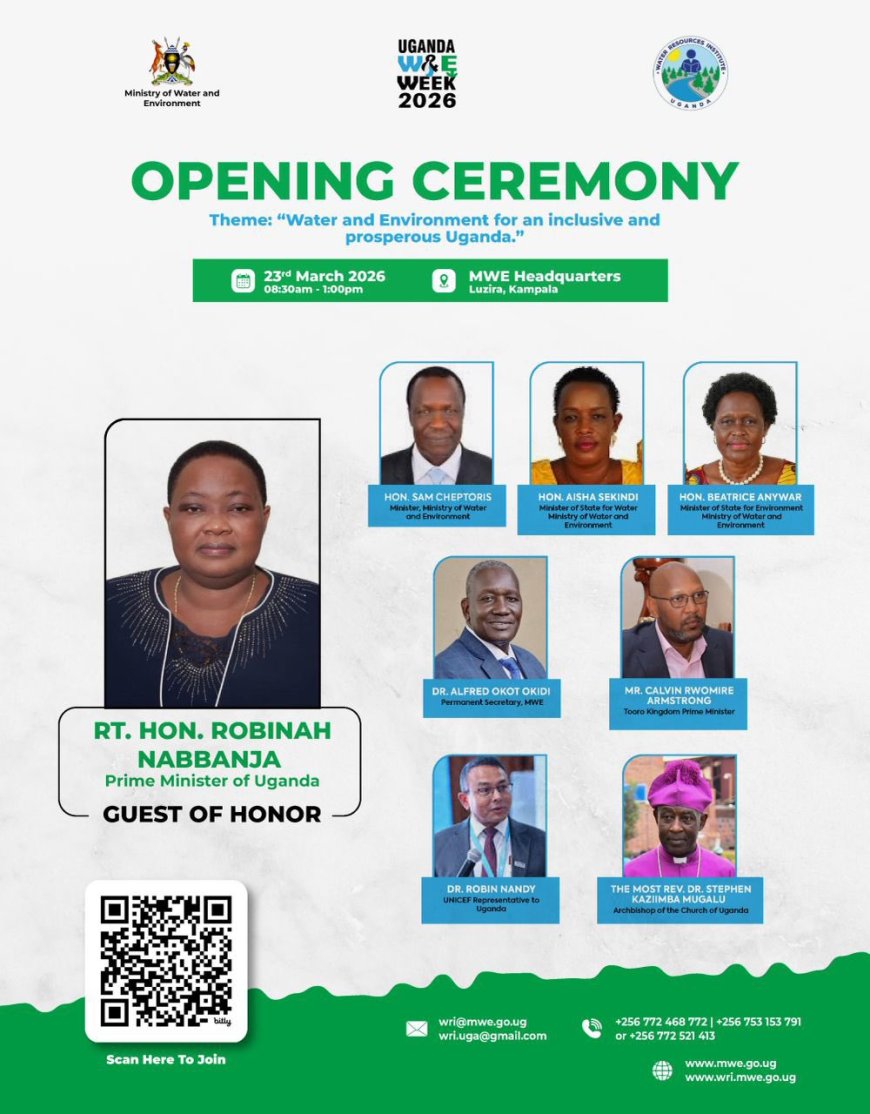
The Ninth Uganda Water and Environment Week (UWEWK) 2026 will take place from March 23–27, 2026, bringing together policymakers, scientists, private sector actors, civil society, academia and development partners to chart a path toward a water-secure and climate-resilient Uganda.
Organised annually by the Ministry of Water and Environment (MWE) through the Water Resources Institute (WRI), UWEWK has evolved since its inception in 2018 into Uganda’s flagship platform for advocacy, knowledge exchange and sector coordination in water, environment and climate action. Over the years, the event has attracted high-level participation from the Vice President, Prime Minister, Chief Justice, Cabinet Ministers, Members of Parliament, cultural and religious leaders, local governments and international partners.
Theme: Water and Environment for an Inclusive and Prosperous Uganda
The 2026 edition will be held under the theme:
“Water and Environment for an Inclusive and Prosperous Uganda.”
The overall goal is to demonstrate the central role of water and environmental resources in achieving Uganda’s Tenfold Growth Strategy, while aligning sector priorities with continental and global frameworks, including African Union Agenda 2063 and the United Nations Sustainable Development Goals (SDGs).
UWEWK 2026 will also integrate outcomes and recommendations from key global and regional platforms such as the UN Water Conference, COP processes, and other major water and climate dialogues, translating them into actionable national strategies.
Anchoring Water and Environment in Uganda’s Tenfold Growth Strategy
Uganda’s Tenfold Growth Strategy aims to expand the country’s economy from approximately USD 50 billion in 2023 to USD 500 billion by 2040. This ambition hinges on four anchor sectors—Agro-Industrial Development, Tourism, Mineral-based Development (including oil and gas), and Science, Technology and Innovation.
Water and environmental resources form the backbone of each of these pillars:
Agriculture depends on reliable water for irrigation and climate-resilient production.
Energy generation, especially hydropower, requires sustainable water flows.
Tourism thrives on healthy ecosystems, forests, wetlands and biodiversity.
Industrialization and petrochemicals require secure and efficiently managed water supplies.
With Uganda’s population projected to grow significantly by 2050, pressures on water resources, forests, wetlands and lakes are intensifying. Climate change—manifested in more frequent floods, droughts and shifting rainfall patterns—further compounds these stresses. UWEWK 2026 will therefore serve as a national reflection point on how to balance economic expansion with ecological sustainability.
Four Strategic Sub-Themes
1. Role of Water and Environment in Achieving Uganda’s Tenfold Growth Strategy
This sub-theme will explore how water security, environmental stewardship and climate resilience can accelerate structural transformation. Discussions will focus on adopting a water-energy-food nexus approach, strengthening infrastructure investment, and ensuring that natural capital is sustainably managed to underpin long-term competitiveness.
Participants will also examine how improved access to clean water and sanitation enhances public health, labour productivity and inclusive growth.
2. Accelerating Progress through Science, Technology, Innovation and Capacity Building
Innovation will be at the heart of UWEWK 2026. The conference will highlight how digital tools such as Artificial Intelligence, big data analytics, spatial mapping and remote sensing can transform water resource monitoring and infrastructure management.
Discussions will address:
Smart water systems and cyber-physical infrastructure
Early warning systems for floods and droughts
Advances in water purification and desalination
Institutional capacity strengthening and skills development
This aligns with global commitments under SDG 6 (Clean Water and Sanitation), SDG 13 (Climate Action) and SDG 14 (Life Below Water).
3. Ensuring Environmentally Sustainable and Climate-Resilient Economies and Communities
With over 80 percent of Uganda’s population dependent on natural resources for livelihoods, the sustainability of forests, wetlands, lakes and rivers is directly linked to economic stability.
This sub-theme will examine:
Integration of climate resilience into national and local planning
Investment in green and grey infrastructure
Nature-based solutions to protect ecosystems
Financing models that support sustainable development
Healthy ecosystems will be framed not merely as environmental assets but as economic safeguards that shield communities from disasters and long-term resource depletion.
4. Leveraging the Power of Women, Youth and Children
Recognising that women and youth are both disproportionately affected by climate change and powerful agents of transformation, UWEWK 2026 will spotlight inclusive participation.
The discussions will focus on:
Strengthening representation in water and environment governance
Supporting women- and youth-led enterprises in WASH and renewable energy
Promoting grassroots innovation and local knowledge
Enhancing financial access for climate adaptation initiatives
By empowering women, youth and vulnerable groups, the sector aims to build resilient communities and foster equitable service delivery.
Pre-Event, Main Event and Post-Event Activities
UWEWK 2026 will adopt a holistic approach, linking previous editions with new sector developments.
Pre-Event Activities
Two to three weeks before the main conference, decentralised activities will be conducted across MWE’s regional structures.
These will include:
Radio and television talk shows
Regional hackathons and youth debates
Marathons and football matches
Clean-up campaigns and tree planting
“Walking for Water, Environment and Climate Change”
Community restoration initiatives
A write-shop to support technical paper presenters
Regional thematic allocations will ensure nationwide participation, with centres such as Fort Portal, Mbarara, Wakiso, Lira, Mbale and Karamoja hosting focused dialogues aligned to specific sub-themes.
Main Event (March 23–27, 2026)
The main conference will feature:
High-level plenary sessions
Technical workshops
Innovation exhibitions
Policy dialogues
Field visits
Commemoration of International Forest Day (March 21), World Water Day (March 22) and World Meteorological Day (March 23)
The event will be conducted in a hybrid format to allow national, regional and international participation.
Expected Outputs and Outcomes
By the end of UWEWK 2026, stakeholders are expected to:
Gain clarity on progress made since UWEWK 2025 and other global engagements
Deepen understanding of water and environment as pillars of Uganda’s economic transformation
Accelerate adoption of science, technology and innovation frameworks
Strengthen financing mechanisms, including blended finance models
Enhance coordination among government, private sector and development partners
Increase participation of women and youth in sector programming
Ultimately, the event seeks to position Uganda as a leader in integrating water security, environmental sustainability and climate resilience into national development planning.
Investment and Commitment
The estimated budget for UWEWK 2026 stands at UGX 1.2 billion , covering pre-event activities, conference logistics, international day commemorations, community engagements, innovation showcases and communication campaigns.
As Uganda aligns its ambitions with continental aspirations under the African Union Vision 2063 and global climate commitments, UWEWK 2026 is expected to provide a decisive platform for translating policy commitments into measurable, inclusive and sustainable action.
Through dialogue, innovation and partnerships, the Ninth Uganda Water and Environment Week aims to reinforce a simple but powerful message: Uganda’s prosperity is inseparable from the health and security of its water and environmental resources.

John Kusolo is a Pastor, Sports Enthusiast and Ugandan journalist with Nile Chronicles News (NCN). With a strong commitment to journalistic excellence, he is recognized for his dedication, goal-oriented approach, and ability to thrive in challenging environments. Kusolo brings focused motivation and professionalism to his reporting and media assignments.









Comments (0)