
Uganda's Hidden Labour Crisis, No Contracts, No Security for Millions of Workers
A sweeping new government survey has laid bare the vulnerability of Uganda's workforce, revealing that nearly nine in every ten employed Ugandans operate without formal contracts leaving millions exposed to job insecurity, exploitation, and poverty with little legal recourse.
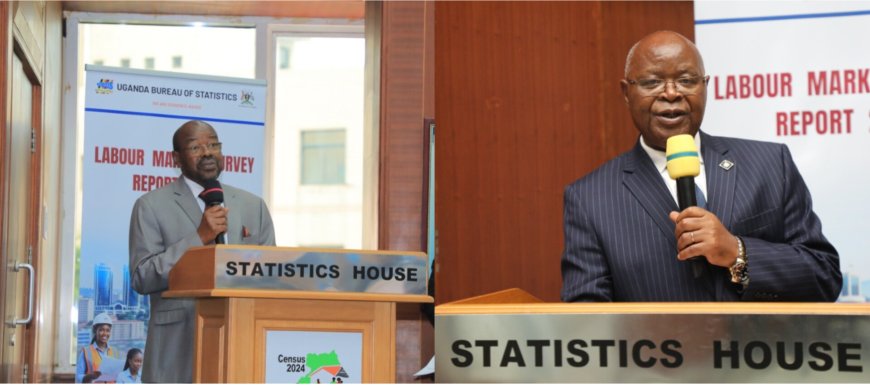
The findings, contained in the Labour Market Survey Report 2025 released by the Uganda Bureau of Statistics (UBOS), Thursday, show that unemployment among the working age population stands at 12.2 percent, with the crisis cutting deepest among young people aged 15 to 24 years, where the rate surges to 18%.
Dr. Vincent Fred Ssenono, the UBOS Deputy Executive Director, who presided over the dissemination of the report, did not mince words about the scale of the challenge.
"About 90% of employed Ugandans do not have formal contracts," he said, a revelation that places the majority of the country's workforce outside the protection of labour laws, social security frameworks, and guaranteed income stability.
The youth unemployment figure of 18% is particularly alarming in a country where a significant proportion of the population falls within the 15 to 24 age bracket precisely the demographic that should be driving economic productivity in the decades ahead.
Without deliberate intervention, analysts warn, the combination of a rapidly growing young population and a labour market ill equipped to absorb them risks deepening inequality and fuelling social unrest.
State Minister of Finance, Planning and Development in charge of Planning Amos Lugoloobi acknowledged the gravity of the findings but projected confidence in the government's strategy to turn the tide.
He pointed to commercial agriculture as a key pillar of the employment solution, urging Ugandans to embrace farming not as a subsistence activity but as a viable and productive enterprise. Alongside this, he said the government was actively working to improve working conditions across sectors.
"These efforts will help Uganda achieve middle income status by 2040," Lugoloobi said, tying the labour market agenda directly to the country's broader development ambitions.
In a move welcomed by planners and development practitioners, UBOS Executive Director Dr. Chris Mukiza announced that the bureau will henceforth publish Labour Market Survey reports on a quarterly basis a significant departure from the infrequent releases that have historically hampered evidence based policy making.
"This will support better government planning and policy implementation for workers," Dr. Mukiza said, signalling that labour statistics will now occupy a more prominent and consistent role in shaping national economic decisions.
The commitment to quarterly reporting is seen as a direct response to longstanding calls from economists and civil society for more timely and granular data on Uganda's evolving jobs landscape.

Benjamin Mwibo is a talented, passionate and creative journalist with a commitment to high quality out put that is factual and researched. Above all Dedicated with a strong desire to identify the truth of the matter.















Comments (0)