
Uganda Earns Global Recognition as National Environment Management Authority Leads Early Submission of 7th Biodiversity Report
According to a press release issued by National Environment Management Authority, Uganda, alongside the European Union, is among the earliest Parties to complete and submit the report. The submission aligns with global obligations under the Convention, where all member states are required to document national progress toward implementing biodiversity protection frameworks. The 7th National Biodiversity Report is a key accountability and planning instrument tracking how countries are advancing the Kunming–Montreal Global Biodiversity Framework, adopted in 2022.
Uganda has earned international recognition after becoming one of the first countries to submit its 7th National Biodiversity Report under the United Nations Convention on Biological Diversity — a milestone that underscores the country’s growing leadership in environmental stewardship and sustainable development.
According to a press release issued by National Environment Management Authority, Uganda, alongside the European Union, is among the earliest Parties to complete and submit the report. The submission aligns with global obligations under the Convention, where all member states are required to document national progress toward implementing biodiversity protection frameworks.
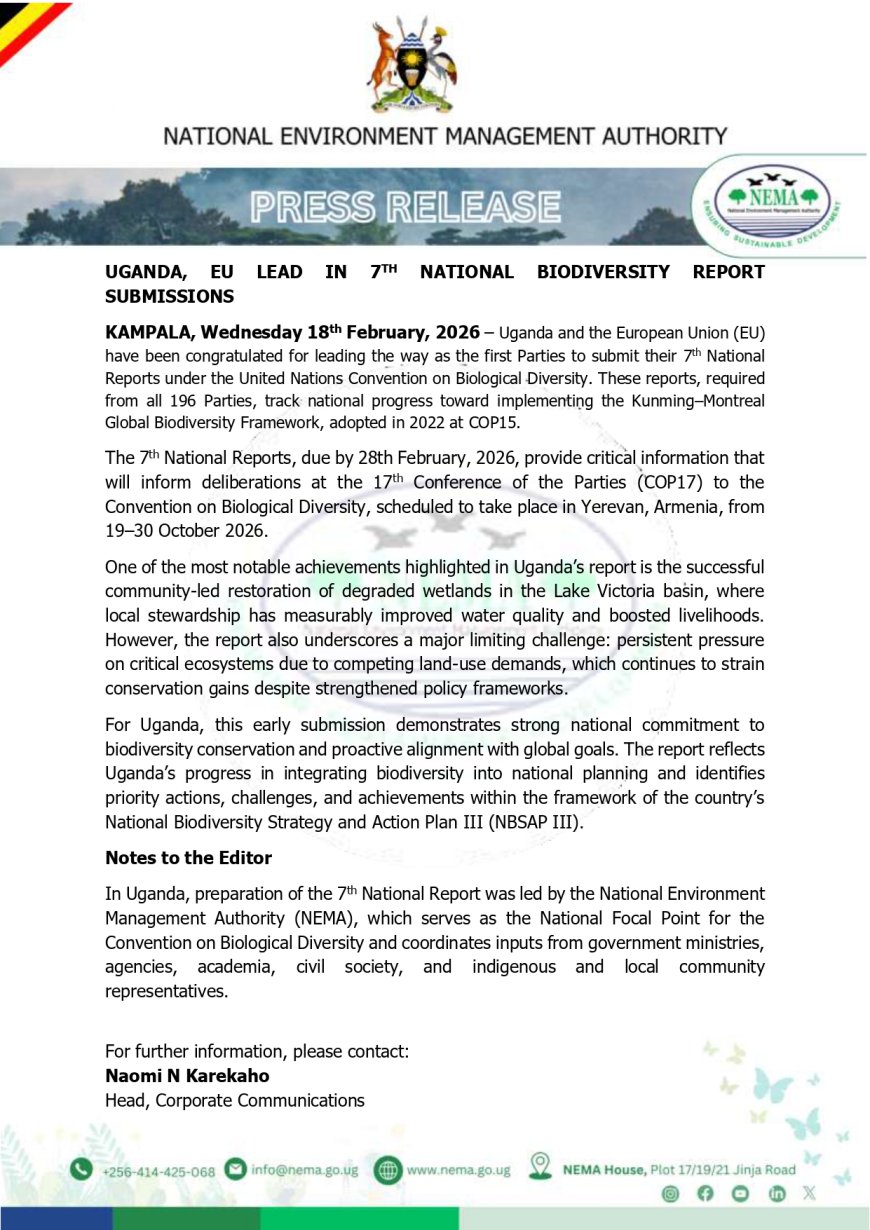
The 7th National Biodiversity Report is a key accountability and planning instrument tracking how countries are advancing the Kunming–Montreal Global Biodiversity Framework, adopted in 2022. These reports collectively help shape international dialogue and decision-making at the 17th Conference of the Parties (COP17), scheduled for October 2026 in Yerevan, Armenia.
Restoration Success and Emerging Challenges
One of the most notable highlights in Uganda’s submission is the success of community-led wetland restoration in the Lake Victoria basin. The report credits local stewardship efforts with measurable improvements in water quality while simultaneously enhancing livelihoods. This approach reflects Uganda’s broader strategy of integrating environmental protection with socio-economic development.
However, the report also acknowledges persistent pressures on ecosystems, particularly from competing land-use demands. Rapid population growth, agricultural expansion, and infrastructure development continue to strain fragile habitats, posing risks to long-term conservation gains despite strengthened policy frameworks.
Commitment to Biodiversity Integration
The early submission signals Uganda’s proactive commitment to biodiversity governance. Authorities emphasize that biodiversity is increasingly being mainstreamed into national development planning, ensuring environmental sustainability is treated as a core pillar rather than a peripheral concern.
The report maps Uganda’s achievements, priorities, and ongoing challenges within the framework of the country’s National Biodiversity Strategy and Action Plan III. This strategic alignment ensures that conservation goals are embedded in sectoral policies ranging from agriculture and water management to urban development.
Coordinated National Effort
Preparation of the report was led by the National Environment Management Authority in its capacity as Uganda’s focal institution for biodiversity matters. The process involved coordination across government ministries, agencies, academic institutions, civil society organizations, and representatives of indigenous and local communities — reflecting a multi-stakeholder approach to environmental governance.
Environmental experts note that such collaborative reporting strengthens transparency, improves policy coherence, and positions Uganda as a regional example in biodiversity accountability.
Global Significance
Uganda’s early submission contributes to a broader global effort to reverse biodiversity loss — a challenge increasingly linked to climate resilience, food security, and economic stability. By documenting both progress and gaps, the country provides valuable insights that inform international conservation strategies.
As COP17 approaches, Uganda’s report is expected to serve as both a benchmark and a catalyst for continued action, reinforcing the principle that sustainable environmental management is inseparable from national development ambitions.

John Kusolo is a Pastor, Sports Enthusiast and Ugandan journalist with Nile Chronicles News (NCN). With a strong commitment to journalistic excellence, he is recognized for his dedication, goal-oriented approach, and ability to thrive in challenging environments. Kusolo brings focused motivation and professionalism to his reporting and media assignments.












Comments (0)