
KCCA ED Hajjat Buzeki Outlines KCCA’s 2025 Gains, Sets Bold Agenda for 2026
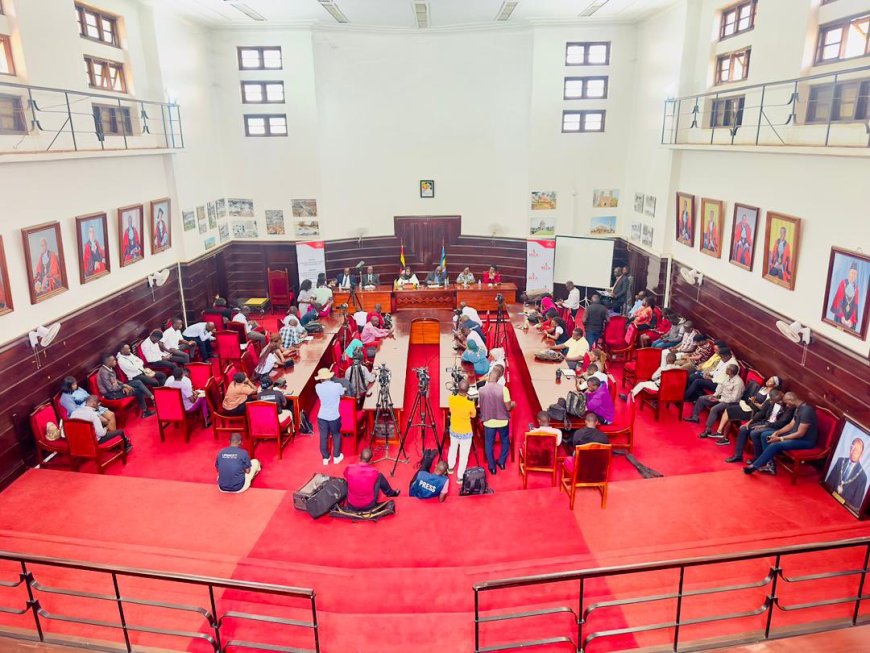
Addressing journalists at City Hall, Buzeki said 2025 had tested the city’s resilience amid rapid urban growth, rising service demand and infrastructure pressure, but noted that KCCA deliberately prioritised delivery over rhetoric.

Kampala — Kampala Capital City Authority (KCCA) Executive Director Hajjat Sharifah Buzeki on December 23 delivered a wide-ranging end-of-year media brief, detailing what she described as a “year of action” for the capital and laying out a firm roadmap for 2026 anchored in systems, accountability and citizen partnership.
Addressing journalists at City Hall, Buzeki said 2025 had tested the city’s resilience amid rapid urban growth, rising service demand and infrastructure pressure, but noted that KCCA deliberately prioritised delivery over rhetoric.
“Cities thrive when facts are clear, leadership is accountable and the media tells the full story — not only of what is broken, but of what is being built,” she said.
Closing the Kiteezi Chapter
One of the most sensitive issues addressed was compensation for families affected by the Kiteezi landfill incident. Buzeki reported that UGX 4.3 billion had been secured for compensation, with 73 out of 96 beneficiaries already paid.
She emphasised that all affected persons were assessed by the Office of the Government Valuer and that payments were made directly to beneficiaries’ bank accounts.
“No brokers. No shortcuts. No excuses. This is how public trust is rebuilt,” she said.
From Waste Crisis to Waste Systems
Waste management dominated the briefing, with Buzeki describing it as “non-negotiable” for a functioning city. She revealed that KCCA had secured 230 hectares of land in Buyala, Mpigi District, for a modern Integrated Waste Management and Resource Recovery Facility, marking a long-term solution beyond Kiteezi.
Waste collection coverage, she said, increased from 53 percent to 63 percent in 2025. Ten acres at Kiteezi were stabilised using Fukuoka technology through a USD 1 million partnership with the Government of Japan and UN-Habitat.
Through the Weyonje sanitation campaign, KCCA reached more than 133,000 households with door-to-door education on waste sorting and recycling, while community clean-ups became routine rather than symbolic.
Buzeki issued a direct appeal to the media to help shape behaviour, stressing that household-level waste sorting is essential for modern cities.
Roads, Bridges and Urban Mobility
On infrastructure, the Executive Director reported significant progress under the Kampala City Roads Rehabilitation Project (KCRRP), with over 80 kilometres of roads rehabilitated or nearing completion, including Old Mubende Road, Wamala, Kabega, Kigala and Luwafu. Key bridges such as Kayemba (95 percent complete) and the Nakawa Railway Crossing (90 percent complete) are nearing completion. Under the Greater Kampala Metropolitan Area Urban Development Programme (GKMA-UDP), 15 roads covering nearly 20 kilometres were launched.
She also highlighted a UGX 550 billion Government-funded road project that will upgrade 87 kilometres of roads across Kampala over three years, with 14 kilometres already under construction.
Smarter Traffic, Reduced Congestion
Buzeki said Kampala had shifted “from chaos to coordination” in traffic management. The Kampala Traffic Control Centre at City Hall is complete, 27 junctions have been signalised, and five roundabouts — including Mulago and Grand Imperial — removed. As a result, average traffic flow improved to four minutes per kilometre, with a strategic target of three minutes per kilometre.
“This is what a city preparing for the future looks like,” she said.
Flood Mitigation and Climate Resilience
Flooding, she noted, was being addressed through prevention rather than apology. Drainage upgrades were undertaken in Bwaise, Kansanga, Ggaba, Kalerwe, Lubigi and Nakamiro, alongside desilting of the Nakivubo and Pan Africa channels.
An inter-agency team led by the Deputy Executive Director now oversees the Nakivubo Channel, while KCCA teams are supporting landlords to improve internal drainage at plot level.
Education, Health and Public Dignity
In the social sector, Buzeki reported construction of 59 new public toilets and renovation of 14 others across schools, markets and public spaces. Classroom construction and renovations were undertaken at several schools, while Phase II of Philip Omondi Stadium commenced as part of youth and community investment.
Markets, Order and Livelihoods
On urban order, Buzeki said Busega Market was commissioned with capacity for over 2,000 vendors, while construction continued at Kiseka and Kitintale markets. Fifteen of the city’s 17 public markets are now fully registered under the “one stall, one vendor” policy.
Additionally, 78 private markets were profiled and sensitised on compliance with the Markets Act, 2023.
Parish Development Model Success
Buzeki described Kampala as the best-performing city under the Parish Development Model (PDM), with UGX 28.5 billion disbursed to 28,516 households across 98 parishes over three years.
She revealed that the President has pledged to increase annual PDM funding per parish from UGX 100 million to UGX 300 million, in recognition of Kampala’s urban population pressures.
“This is how we reduce urban poverty — one enterprise at a time,” she said.
Governance, Beautification and Revenue
The Executive Director highlighted the launch of KCCA’s Five-Year Strategic Plan (2025/26–2029/30), service delivery standards and a client charter. In July 2025, powers were fully devolved to the city’s five divisions.
She also underscored investments in beautification, tree planting and green spaces, noting improved air quality and urban aesthetics along major roads such as Jinja Road and Nile Avenue.
On revenue, KCCA surpassed its collection target, raising UGX 69 billion against a target of UGX 63 billion by mid-December 2025, representing 110 percent performance, driven by digitalisation and reduced leakages.
Looking Ahead to 2026
Among key priorities for 2026, Buzeki listed completion of major roads, operationalisation of the Buyala landfill, upgrading 47.7 kilometres of drainage, completion of Kiswa Health Centre maternity ward, and expansion of markets and air quality monitoring.
Call for Media Partnership and Calm Elections
As Uganda approaches the January 2026 elections, Buzeki appealed to the media to promote calm, factual and responsible reporting.
“When the media lowers the temperature, democracy breathes,” she said, urging dialogue over division and truth over speculation.
She concluded with a festive road safety message and called for continued partnership with residents and the media to build a cleaner, safer and more liveable Kampala.

John Kusolo is a Pastor, Sports Enthusiast and Ugandan journalist with Nile Chronicles News (NCN). With a strong commitment to journalistic excellence, he is recognized for his dedication, goal-oriented approach, and ability to thrive in challenging environments. Kusolo brings focused motivation and professionalism to his reporting and media assignments.







Comments (0)