
President Museveni Sets Out 11 Strategic Priorities to Fast-Track Uganda’s Economic Transformation
Speaking during Day Four of the National Resistance Movement (NRM) retreat at the National Leadership Institute Kyankwanzi, Museveni challenged leaders to shift from theory to practical, results-driven interventions that directly impact productivity, incomes, and livelihoods.
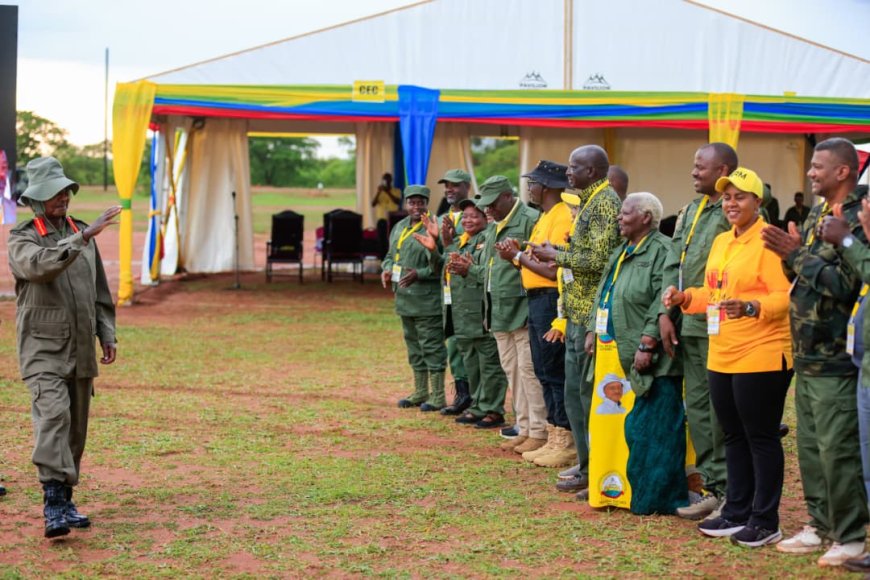
President Yoweri Kaguta Museveni has laid out an ambitious but structured roadmap to accelerate Uganda’s economic transformation, anchoring his message on eleven strategic priorities aimed at achieving tenfold growth.
Speaking during Day Four of the National Resistance Movement (NRM) retreat at the National Leadership Institute Kyankwanzi, Museveni challenged leaders to shift from theory to practical, results-driven interventions that directly impact productivity, incomes, and livelihoods.
At the heart of his message was a call for value addition, which he described as one of Uganda’s biggest missed economic opportunities. Using coffee as an example, he illustrated how exporting raw produce significantly limits earnings, while processing and branding could multiply revenues by more than ten times. This, he emphasized, should become a central focus of Uganda’s industrial strategy.
Closely linked to this is the push to fully monetize the economy. Museveni pointed out that many Ugandan households, particularly in rural areas, remain outside the money economy due to subsistence farming. Through initiatives like the Parish Development Model, the government aims to transition these households into commercial production, thereby expanding the country’s taxable and productive base.
Looking ahead, the President stressed the urgency of building a knowledge-based economy driven by science, technology, and innovation. He urged a shift from reliance on traditional exports like coffee and cotton to high-value industries such as pharmaceuticals, automobile manufacturing, and electronics production—sectors he believes are key to long-term competitiveness.
Infrastructure development emerged as another cornerstone of the strategy. Museveni highlighted the economic benefits of investing in railway transport, noting that reducing the cost of moving goods would directly enhance business profitability and regional trade. Affordable and reliable electricity was also underscored as critical for industrial growth, with existing investments needing to translate into consistent supply for manufacturers.
On financing, the President called for deliberate efforts to lower the cost of credit, particularly for producers. He emphasized that government-backed financing should prioritize wealth creation activities such as manufacturing, rather than consumption-driven ventures.
Museveni also pointed to the transformative role of digital systems in improving revenue collection and sealing leakages. However, he cautioned that corruption remains a major bottleneck, cutting across all sectors and undermining progress. He stressed that tackling graft must be treated as a cross-cutting priority that supports all other interventions.
In the social sector, the President advocated for cost-effective service delivery, especially through preventive healthcare and accessible education. He argued that a significant proportion of illnesses can be avoided through basic interventions such as immunization, proper nutrition, and hygiene, which in turn reduces pressure on public health systems and improves productivity.
The creative and services sector was also highlighted as an emerging economic driver. Museveni acknowledged the growing contribution of industries like music, sports, and entertainment, particularly among the youth, and called for structured support to harness their full potential.
Urban planning, especially within the Greater Kampala Metropolitan Area, was identified as another critical area. Addressing challenges such as traffic congestion in Kampala, he noted, would significantly boost economic efficiency by saving time and reducing operational costs for businesses.
In concluding his address, Museveni reiterated that while the priorities are clear, success will depend on disciplined implementation and focused leadership. He urged policymakers to remain aligned on these core areas, emphasizing that Uganda already possesses the necessary resources and potential—the task now is to organize effectively and execute with precision.

John Kusolo is a Pastor, Sports Enthusiast and Ugandan journalist with Nile Chronicles News (NCN). With a strong commitment to journalistic excellence, he is recognized for his dedication, goal-oriented approach, and ability to thrive in challenging environments. Kusolo brings focused motivation and professionalism to his reporting and media assignments.











Comments (0)